

Co-sourcing is a flexible delivery model where internal teams and external specialists work together to deliver defined activities. Unlike traditional outsourcing, the organisation retains ownership of key decisions, controls and oversight, while the external team provides additional expertise and capacity within the organisation’s governance framework.
The legal and regulatory treatment of a co-sourcing arrangement depends on how the services are delivered in practice, including the activities performed, systems and data access, decision-making responsibilities and level of operational dependency, rather than simply how the arrangement is described.
Key takeaways
- Co-sourcing works best when the scope, owners, preparers, reviewers, approvers and escalation routes are explicit.
- The external team may prepare work, perform agreed activities or provide specialist input. The organisation should retain appropriate ownership, oversight and approval authority, subject to the operating model and any applicable regulatory requirements.
- Benefits such as additional capacity, access to specialist skills and greater resilience depend on the design and management of the arrangement. They are not automatic outcomes.
- System access, data handling, evidence retention, service continuity and exit planning should be agreed before delivery begins.
- Regulated firms must assess the arrangement under the rules that apply to their entity, activity and jurisdiction. Calling an arrangement “co-sourcing” does not remove outsourcing or third-party risk obligations.
What does co-sourcing mean in finance?
In finance, co-sourcing generally describes an operating model in which an organisation’s internal team and an external provider share defined activities, processes or workstreams.In practice, the distinction is created by the operating model and SLAs rather than the label.
A useful co-sourcing arrangement states:
- which activities remain internal;
- which activities the external team will perform;
- where judgement, review and approval sit;
- which systems, records and data the provider may access;
- how performance, exceptions and incidents will be reported; and
- how work and knowledge will be transferred if the arrangement ends.
This makes co-sourcing different from simply adding people to an unresolved workload. The aim is to establish a controlled way of delivering specific outcomes while retaining sufficient knowledge and accountability within the organisation.
How co-sourcing works
Although the detail varies, a well-controlled finance co-sourcing process usually has six stages:
1. Define the need and assess the risk
Start with the activity, outcome or capacity constraint. Document the current process, critical deadlines, known control weaknesses, data involved and consequences of failure. This determines whether the work is suitable for external support and what due diligence is proportionate.
2. Set the scope and responsibilities
Translate the requirement into deliverables, service levels and a responsibility matrix. Name the internal process owner, the people who prepare and review each output, the approver, and the route for escalating overdue work or disputed judgements. Avoid descriptions such as “support the finance team” that leave ownership open to interpretation.
3. Design access and information handling
Give each external team member an individual account and only the access needed for the assigned work. Agree how information will be transferred, stored, retained and deleted; how access will be approved and reviewed; and how leavers or role changes will be handled. Where personal data is processed, the parties should determine their roles and the contractual requirements that apply in the relevant jurisdiction.
4. Onboard against a controlled baseline
Provide approved procedures, chart-of-accounts guidance, reporting calendars, materiality or escalation thresholds where applicable, and examples of accepted evidence. Resolve gaps in source data or process documentation before treating delivery as business as usual.
5. Deliver, review and evidence the work
The provider completes the agreed activity and retains evidence in the designated system. A named reviewer checks the output against defined criteria. Exceptions are logged, assigned, aged and escalated. Approval should be evidenced rather than inferred from silence or the passage of a deadline.
6. Monitor and improve the arrangement
Regular service reviews should consider quality, timeliness, recurring exceptions, rework, control failures, access issues and upcoming changes. Corrective actions need an owner and due date. The organisation should also maintain a workable continuity and exit plan so that provider disruption does not leave a critical process without records, knowledge or authorised access.
Where finance co-sourcing can be used
The model can be applied to recurring processes, temporary projects or specialist work. The precise allocation should reflect the organisation’s systems, control environment and regulatory position.
1. Period-end close, management reporting and audit support
An external team might prepare reconciliations, maintain close trackers, compile reporting packs, investigate variances and support audit requests by preparing schedules, coordinating evidence and responding to information queries. Internal management can retain responsibility for accounting judgements, review, approval and communication of results, as well as key decisions arising from the audit. Evidence should show who prepared and reviewed each item, when it was completed, how exceptions were resolved and how audit requests were tracked through to closure.
2.Fund accounting and administration support
Co-sourced support may cover agreed elements of cash and position reconciliations, capital activity schedules, investor-data maintenance, fee calculations or NAV working papers. The allocation of work between the fund manager, fund administrator and co-sourced provider should be documented, particularly for source data, valuation inputs, review, approval and investor communications. Final responsibilities will depend on the fund structure, governing documents, service agreements and applicable regulatory requirements.
3.Operational execution
An external team can support agreed operational tasks such as maintaining compliance calendars, gathering information, updating internal records and assembling review evidence. Responsibility for regulatory decisions, approvals and submissions should be allocated according to the applicable rules and engagement terms. Legal or regulatory advice may be required where an entity-specific interpretation is needed.
4.Change, remediation and systems work
Co-sourcing can add capacity for data cleansing, process documentation, control remediation, system implementation support or backlog reduction. Acceptance criteria should be agreed at the outset, with reconciliation back to authoritative records and formal sign-off before a revised process goes live.
5.Project-based and temporary assignments
A defined project or professional secondment can help cover a reporting peak, transition or temporary skills gap. The arrangement still needs documented supervision, access controls, deliverables and handover requirements. Temporary does not mean informal.
Potential benefits and limitations
Co-sourcing can offer access to skills that are difficult to maintain permanently, additional capacity during peaks and a way to complete a defined project without redesigning the whole finance function. Because internal and external teams work together, it can also support knowledge transfer and preserve internal context.
Those benefits depend on execution. Co-sourcing can create role ambiguity, provider dependency, fragmented process knowledge, access risk and duplicated review if the model is poorly designed. It may also cost more than expected where the scope changes frequently or internal inputs are consistently late. A business case should therefore compare the full cost and risk of realistic options rather than assume co-sourcing is cheaper than recruitment or outsourcing.
Co-sourcing is unlikely to solve a process that has no clear owner, reliable source data or agreed control standard. In those circumstances, the first step is to stabilise the process and decide which responsibilities can sensibly be shared.
Professional secondments are temporary arrangements used to support a defined project, period of change or short-term operational requirement. Co-sourcing is generally a longer-term delivery model covering an agreed scope of work, with service-level agreements, responsibilities, review standards and escalation procedures established between the parties.
The difference is usually one of operating design and degree, not a complete transfer of accountability.
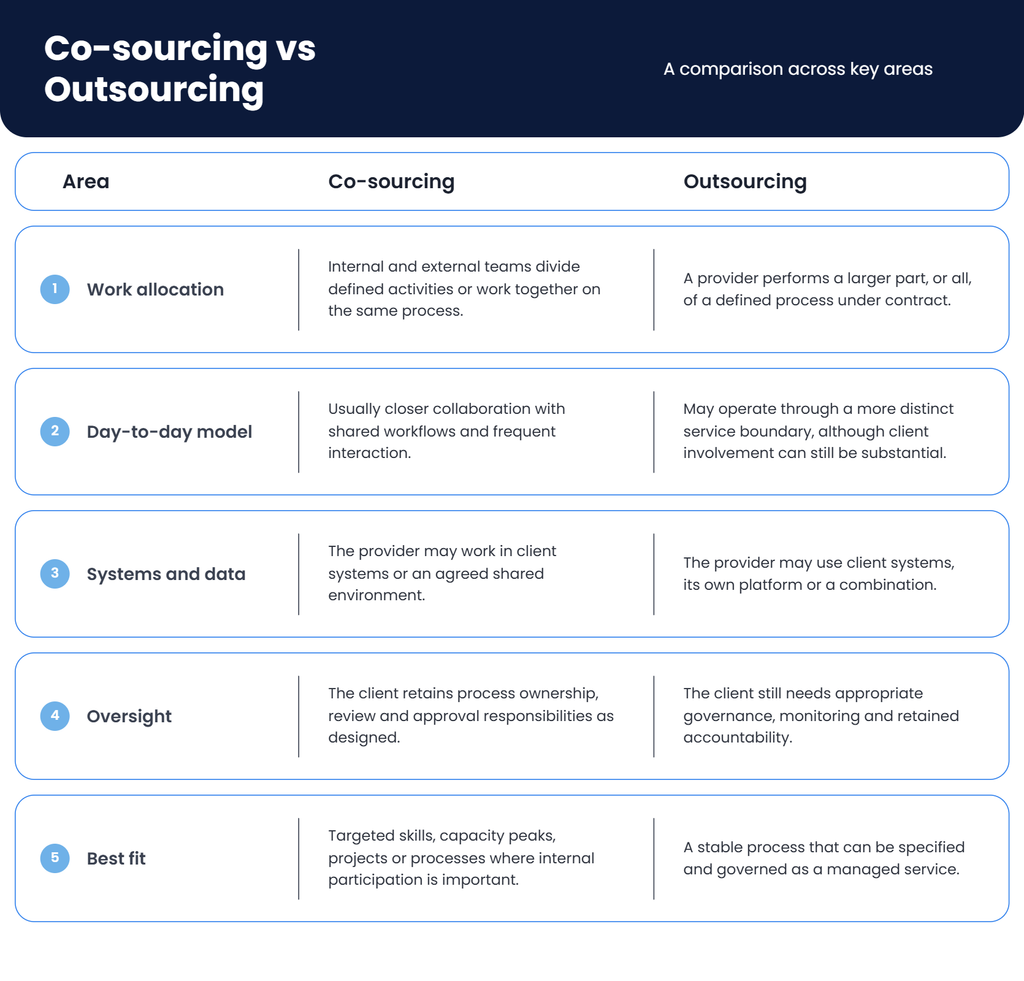
For UK-regulated firms, describing an arrangement as co-sourcing does not determine its regulatory treatment. The applicable requirements depend on the type of firm, the services involved and whether the arrangement constitutes outsourcing, including whether a critical or important operational function is involved. Firms within the scope of SYSC 8 remain responsible for their regulatory obligations when such functions are outsourced. The applicable FCA Handbook provisions should therefore be assessed for the specific arrangement.
Controls that make co-sourcing effective
Before delivery begins, finance leaders should be able to answer the following questions.
- Scope: What is included, excluded and dependent on another team or provider?
- Ownership: Who owns the process and the risks? Who prepares, reviews and approves each output?
- Standards: Which accounting policies, procedures, tolerances and acceptance criteria apply?
- Evidence: Where are source records, workings, review notes, approvals and exception logs retained?
- Escalation: What triggers escalation, to whom, and within what timeframe?
- Access: Which systems and data are required, who approves access, and how often is it recertified?
- Failure response: What happens if a deadline is missed, a control fails, an error is identified or the provider is unavailable?
- Change and exit: How are scope changes approved, and how will records, access and knowledge be returned or transferred at the end?
The measures used to monitor delivery should reflect the process. Useful indicators may include close-timetable adherence, aged reconciling items, review points, rework, unresolved exceptions, access exceptions and completion of agreed corrective actions. A service-level result should not replace review of whether the underlying control operated effectively.
How to choose a co-sourcing partner
A provider assessment should test how delivery will work, rather than rely on a broad capability statement. Ask for evidence of:
- relevant technical competence and supervision;
- a delivery model that fits the required deadlines and systems;
- quality-control, issue-management and escalation processes;
- information-security and business-continuity arrangements;
- use and oversight of subcontractors or sub-processors;
- conflicts, independence considerations and confidentiality controls;
- transparent pricing, assumptions and change control; and
- transition-in, knowledge-transfer and exit support.
References, sample deliverables and scenario-based discussions can help test whether the proposed team understands the work. Contract terms should align with the operating model, including responsibilities, service standards, audit or assurance rights where appropriate, incident handling, liability, intellectual property, data provisions and termination assistance. Legal review may be required.
How We Supports Co-Sourcing
We provides co-sourced support across operational finance, accounting, compliance and administration, working within a client’s existing systems, procedures and control framework.
Support can be structured around defined activities, projects or broader operational requirements, from period-end reporting, reconciliations and finance operations to fund administration, investor services, compliance support, system migrations and process improvement. Our teams integrate with existing internal functions and can scale as requirements change.
Each engagement has a clearly agreed scope, with responsibilities, review points, deliverables and escalation routes documented from the outset. This allows clients to retain appropriate ownership, governance and oversight while adding specialist expertise and operational capacity where it is needed.
Frequently asked questions
Is co-sourcing the same as staff augmentation?
Does co-sourcing improve compliance and reporting accuracy?
How long does co-sourcing onboarding take?
Is co-sourcing more cost-effective than outsourcing?
What is the difference between co-sourcing and professional secondments?