

ESG investing refers to investment approaches that consider environmental, social and governance information in research, portfolio construction, risk management, stewardship or the pursuit of sustainability outcomes.
The term alone does not explain how those factors affect investment decisions or what the strategy is intended to achieve. Evaluation should therefore begin with the mandate, methodology, holdings, data, governance and disclosures, rather than relying on an ESG score or product name.
Key takeaways
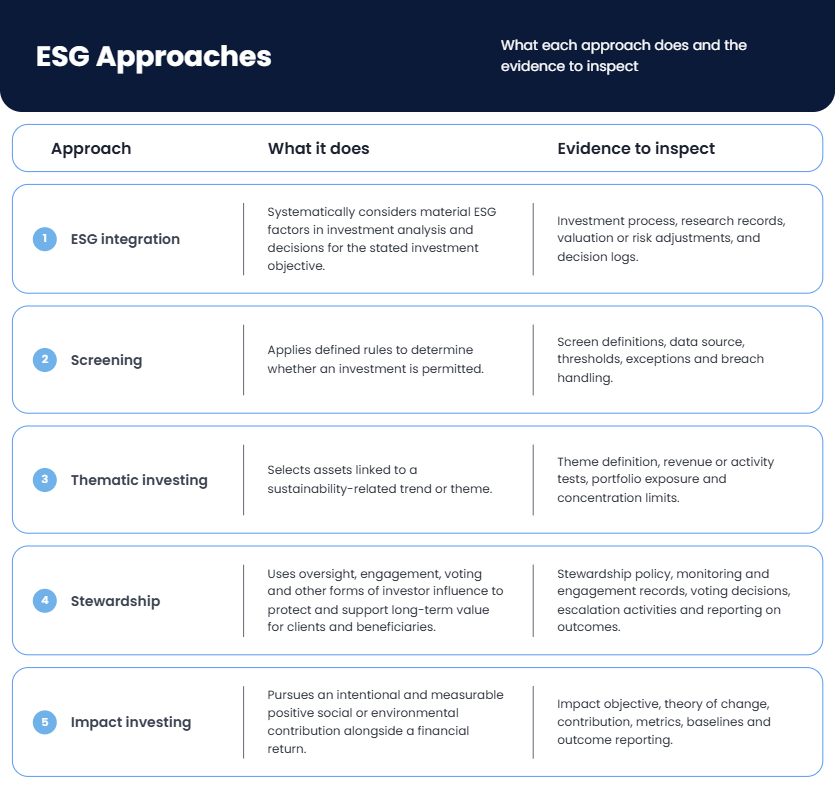
- ESG integration, screening, thematic investing, stewardship and impact investing are distinct approaches. They may be combined, but they should not be treated as interchangeable.
- An ESG rating is an input produced under a particular methodology, not a universal judgement on whether an investment is sustainable or suitable.
- Product claims should be tested against the mandate, binding investment rules, actual holdings, monitoring process and reported results.
- Regulatory requirements depend on the product, firm and jurisdiction. Global disclosure standards do not become mandatory everywhere simply because they have been issued.
What ESG investing means in practice
Environmental, social and governance factors can affect an issuer’s cash flows, access to finance, cost of capital or ability to operate over time. An investment process may also consider the effects of investment decisions on people and the environment.
These are different perspectives: one considers how sustainability-related matters may affect financial prospects, while the other considers the sustainability effects of investment decisions. A credible methodology should explain which perspective it applies, or how it combines the two.
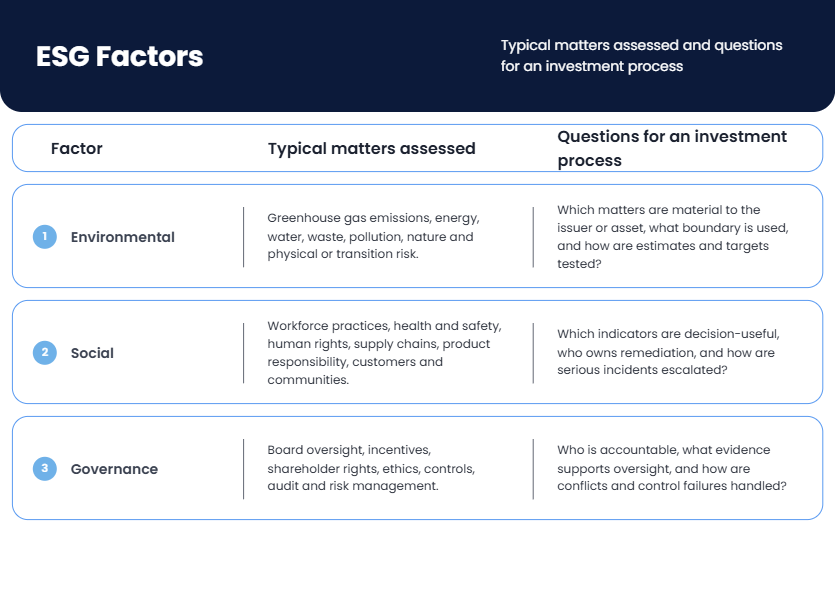
Material ESG factors vary by industry, business model and asset class. A generic checklist can provide a starting point, but it cannot determine which factors are material to a particular investment.
Source: IFRS Foundation, SASB Standards
The main ESG investment approaches
A product can use more than one approach. The investment documents should explain the role of each approach and whether it creates a binding portfolio rule or is simply part of research and risk management.
Source: PRI, CFA Institute and GSIA definitions for responsible investment approaches
How to evaluate an ESG investment
1. Start with the objective and mandate
Identify what the strategy is trying to achieve. A mandate may use ESG information to manage financially material risks, apply investor preferences, pursue a sustainability theme, influence issuers through stewardship, or target measurable impact. These objectives lead to different portfolio rules and evidence requirements.
Review the applicable governing and offering documents, which may include the prospectus, limited partnership agreement, investment management agreement and relevant policy documents, alongside the marketing materials. Sustainability-related statements in marketing should be consistent with the product’s binding terms and disclosed investment approach.
Any material inconsistency should be investigated, documented and resolved through the organisation’s governance and approval process before the claim is used in investor communications or relied on in an investment decision.
2. Test the methodology and materiality assessment
A methodology should define the investment universe, applicable screens, material factors, data sources, weighting, treatment of missing data and the role of judgement. It should also explain whether an ESG characteristic affects eligibility, position size, valuation, monitoring or engagement.
Materiality assessments should be reviewed when relevant circumstances change. A factor may become more significant following a regulatory change, operational incident, acquisition or change in business model. Responsibility for preparing, reviewing, challenging and approving the assessment should be documented in accordance with the organisation’s governance arrangements.
Depending on the operating model, this may involve investment, risk, compliance, sustainability or product-governance functions.
3. Look through the label to holdings and exposures
Review actual and permitted holdings, sector and geographic exposures, derivatives, cash, look-through limitations and concentration. A portfolio can satisfy its methodology and still carry exposures that an investor did not expect. The question is whether those exposures are consistent with the disclosed objective and risk limits, not whether every holding has a high external score.
4. Assess the data and estimates
Record who supplies each material data field, its reporting period, coverage, calculation boundary, assurance status and any estimate used. Controls should identify stale data, unexplained movements, missing values and conflicts between sources. Overrides should state the rationale, approver, effective date and review date.
5. Examine governance, monitoring and failure response
A controlled process assigns ownership. Investment teams may prepare the analysis; risk, compliance or product governance may review it; and an investment committee, board or authorised delegate may approve material decisions. The precise model varies, but responsibilities and escalation routes should be documented.
Retained evidence should include the methodology in force, source data, calculations, approvals, exceptions, engagement records and reports issued to investors.
The process should explain what happens when data becomes unavailable or unreliable, an investment restriction is breached, or a sustainability-related claim cannot be supported. It should cover the immediate response, assessment of affected decisions and disclosures, escalation, correction and any required communication.
Using an external data, technology or administration provider does not remove the responsibilities that remain with the firm under applicable law, regulation, governing documents and contractual arrangements. The firm should therefore define and evidence how outsourced activities are monitored and overseen.
Why ESG ratings differ
An ESG rating expresses a provider’s assessment of an issuer, asset, fund or other subject using that provider’s own scope and methodology. Providers may assess different matters, including exposure to sustainability-related financial risks, management of those risks, sustainability characteristics or real-world effects. Two ratings can therefore disagree without either one being a calculation error.
IOSCO has identified concerns including transparency, methodologies, data gaps, conflicts of interest and communication with rated entities. A due diligence file should capture what a rating measures, the data vintage, the treatment of missing information, the update cycle and any known limitations. A rating can support analysis, but should not replace review of the underlying evidence.
In the EU, Regulation (EU) 2024/3005 on ESG rating activities applies from 2 July 2026. It introduces requirements relating to the transparency, governance and independence of ESG rating providers operating within its scope. The regulatory framework does not make ESG ratings interchangeable: users should still understand the methodology, data, scope and limitations of the particular rating being used.
Source: IOSCO, ESG Ratings and Data Products Providers
Disclosure standards and regulatory context
Disclosure frameworks can improve the information available to investors, but scope and legal effect must be checked by jurisdiction. A global standard, a product disclosure regime and an accounting standard perform different jobs.
Global baseline: IFRS S1 and IFRS S2
IFRS S1 requires an entity applying the standard to disclose material information about sustainability-related risks and opportunities that could reasonably be expected to affect its cash flows, access to finance or cost of capital over the short, medium or long term.
It covers governance, strategy, risk management, and metrics and targets. IFRS S2 addresses climate-related disclosures. Both are effective for annual reporting periods beginning on or after 1 January 2024, but mandatory application depends on adoption or other legal requirements in the relevant jurisdiction.
Source: IFRS Foundation, IFRS S1
United Kingdom: SDR and the anti-greenwashing rule
For firms and products within scope, the FCA’s Sustainability Disclosure Requirements include naming and marketing rules, disclosure requirements and optional investment labels. The FCA’s anti-greenwashing rule applies to FCA-authorised firms when they make references to the sustainability characteristics of products or services in relevant communications with UK clients or financial promotions communicated in the UK.
Such references must be consistent with the sustainability characteristics of the product or service and be fair, clear and not misleading. The application of the wider SDR requirements depends on the firm, product, communication and distribution model.
Source: FCA, Sustainability Disclosure Requirements regime | FCA, anti-greenwashing guidance FG24/3
European Union: SFDR
The Sustainable Finance Disclosure Regulation is a transparency framework for financial market participants and financial advisers. It requires entity-level and product-level sustainability disclosures within its scope; it does not require all in-scope firms to invest according to green criteria. The European Commission proposed substantial amendments in November 2025, including a proposed product-categorisation system. The Council adopted its negotiating position in June 2026, but the legislative process remains ongoing. The proposed changes should therefore not be described as current legal requirements unless and until the legislation is adopted and the relevant provisions take effect.
Source: European Commission, sustainability-related disclosure in the financial services sector
ESG investment evaluation checklist:
- Confirm the investment objective and binding requirements.
- Review the methodology, data sources and use of estimates.
- Test whether holdings and exposures match the stated approach.
- Confirm governance, monitoring and approval responsibilities.
- Review the evidence supporting disclosures and sustainability claims.
Used carefully, ESG analysis can bring additional information into investment research, focus attention on material operational or governance risks, and make investor preferences or sustainability objectives more explicit. Stewardship can also provide a structured route for exercising investor rights and monitoring engagement objectives.
The limitations are equally important. Data may be incomplete or estimated, methodologies can diverge, portfolio labels can obscure different objectives, and thematic or screened approaches can alter diversification and tracking error. None of these approaches guarantees better returns, lower risk or positive real-world outcomes. The appropriate assessment depends on the mandate, evidence and investor’s decision framework.
From ESG intent to controlled execution
A credible ESG investment process connects its stated objective to binding rules, research, portfolio decisions, monitoring, evidence and reporting. Senior decision-makers should be able to trace a claim from the public wording back to an approved methodology and the records showing how it operated in practice.
Project Accountants supports funds and finance businesses through fund administration support, operational finance outsourcing, compliance support, financial analysis, company secretarial and governance support, technical training and professional secondments. Where ESG-related work falls within those areas, support can be scoped as outsourced, project-based or secondment capacity working within the client’s systems and controls. Investment selection and regulated advice remain with appropriately authorised decision-makers.
Frequently asked questions
Which ESG factors matter most?
What is the difference between ESG integration and impact investing?
Why do ESG ratings differ between providers?
How should an ESG investment be evaluated?
Does a high ESG rating mean an investment is sustainable?
What should investors look for in ESG data?
Are IFRS S1 and IFRS S2 mandatory for all organisations?
What is greenwashing in ESG investing?
Can ESG activities be outsourced?