

Governance support services provide additional capacity to organise board and committee work, maintain governance documents, coordinate meetings, improve board information, record decisions, track actions and support assurance processes. The provider can prepare and administer the process, but directors retain responsibility for their judgement, decisions and applicable legal or regulatory duties.
A board can have experienced directors and still lose effectiveness through late papers, unclear decision rights, recurring actions or incomplete evidence of challenge. These are operating problems with governance consequences. They make it harder for directors to understand what is being asked, test management’s assumptions and show how a decision was reached.
This guide is for governance, compliance and operations leaders supporting boards in regulated financial-services, fiduciary and finance businesses. It explains what governance support can cover, when additional capacity is useful, how to preserve director accountability and what to test when selecting a provider. The exact duties, board structures and records required depend on the entity, constitution, sector and jurisdiction.
Key takeaways
- Define the governance outcome before buying capacity. The need may concern meeting discipline, board information, policy ownership, action closure, statutory records or assurance coordination.
- Keep decision rights explicit. A support provider may draft, coordinate and challenge process quality, but the authorised board, committee or internal owner must make and approve the decision.
- Treat the board cycle as one controlled process. Calendar, agenda, papers, conflicts, minutes, actions and follow-up evidence should connect.
- Measure quality as well as timeliness. An on-time pack can still be weak if it is incomplete, inconsistent or unclear about the decision required.
- Select support for operating fit, governance judgement, security, resilience and hand-back arrangements, not for document production alone.
What governance support services include
The scope should follow the organisation’s governance framework and the board’s priorities. Common activities include maintaining the annual board and committee calendar; coordinating agendas and papers; administering meetings; drafting minutes and decision records; tracking actions; maintaining terms of reference, policies and authority schedules; supporting board information standards; coordinating performance reviews; and organising evidence for assurance or regulatory requests.
Some engagements also sit close to company secretarial work, such as maintaining entity records, tracking statutory events and coordinating filings. The exact boundary matters. “Governance support” should not be assumed to include legal advice, formal company-secretary appointments, regulatory interpretation or filing authority unless those services and responsibilities are specifically confirmed.
A useful scope separates each activity into five roles:
- Owner: accountable for the governance outcome or obligation.
- Preparer: assembles the paper, policy, agenda, minute or evidence.
- Reviewer: checks accuracy, completeness, consistency and process compliance.
- Approver: exercises the authority to adopt, decide or release.
- Administrator: coordinates timing, access, version control and retained records.
These roles may be performed by internal staff, directors and an external provider in different combinations. The responsibility matrix should also state what happens when information is late, a conflict arises, quorum is uncertain, a decision exceeds delegated authority or an action remains overdue.
The G20/OECD Principles of Corporate Governance provide a useful international reference point: board structures vary across jurisdictions, while the board remains responsible for strategic guidance, monitoring management and accountability. This supports a clear distinction between governance infrastructure and the board’s substantive role. The Principles are a benchmark, not a statement of the law applying to every entity.
When organisations need additional governance capacity
The clearest signs are recurring process failures or a material change that the existing team cannot absorb. Examples include rapid entity or fund growth, new committees, a transaction, a regulatory remediation programme, a new board chair, executive turnover, a provider transition, a governance review, or several important meetings competing for the same internal resources.
Operational indicators include:
- Papers arriving too late for meaningful review.
- Agendas dominated by routine reporting while strategic decisions are deferred.
- Inconsistent versions or missing approvals.
- Minutes that do not clearly distinguish discussion, challenge, decisions and actions.
- Overdue actions without escalation or closure evidence.
- Policies with no clear owner, review date or approval record.
- Duplicated requests to management because committees do not coordinate.
- A key-person dependency in the company secretarial or governance team.
Before appointing support, diagnose the cause. More administrators will not fix unclear decision rights, a chair who does not control the agenda or management reports that avoid the central issue. The answer may be process redesign, clearer leadership expectations, better templates, technology, targeted training, temporary project capacity or an ongoing co-sourced model.
Use a short baseline review: sample two or three board cycles, compare scheduled and actual paper dates, examine decision and action logs, and ask directors whether the information was timely and decision-ready. This creates a specific brief and a starting point for measuring improvement.
How to strengthen board and committee operations
Start with the annual calendar. Map recurring approvals, strategy sessions, financial reporting, risk and compliance matters, policy reviews, regulatory dates and committee dependencies. Work backwards to management preparation and review cut-offs. Reserve time for foreseeable decisions instead of adding every material item at the final agenda-setting meeting.
Terms of reference should state purpose, authority, membership, quorum, meeting frequency, reporting lines and matters reserved for the board. Review them when the business, regulation or committee structure changes. A committee can analyse and recommend within its mandate, but the board retains responsibility for matters that have not been delegated or cannot lawfully be delegated.
For each meeting, the chair, company secretary or governance lead should agree the purpose of each item: decision, discussion, assurance or information. The agenda should identify the responsible presenter, paper owner, time allocation and required outcome. Consent or routine items can be handled efficiently, provided the applicable process allows it and directors can raise questions.
The 2024 UK Corporate Governance Code is a specific UK listed-company framework. Within its scope, it states that the board, supported by the company secretary, should have the policies, processes, information, time and resources needed to function effectively. The Code applies to financial years beginning on or after 1 January 2025, with Provision 29 applying from 1 January 2026. Other organisations can draw practical questions from it, but should not present Code provisions as their own obligations without confirming applicability.
Keep policies and decision rights usable
A policy library is useful only when people can identify the current rule and the person authorised to act. Maintain an inventory with the policy owner, approving body, effective date, next review, related procedures, exceptions and superseded versions. Link material policies to the risks and obligations they address.
Decision rights should be consistent across the constitution, board-reserved matters, committee terms of reference, delegated-authority matrix, bank mandates and operational procedures. Conflicts between these documents create uncertainty precisely when a decision is urgent. Governance support can coordinate the comparison and track amendments, while legal interpretation and formal approval remain with the appropriate advisers and governing body.
Record the decision path for material matters. A good approval paper identifies the decision requested, authority, recommendation, alternatives, financial and operational effect, material risks, conflicts, dependencies and implementation owner. It should distinguish facts from assumptions and state where specialist advice has been obtained.
Exceptions need a controlled route. Record the request, policy or authority affected, reason, risk assessment, approving authority, conditions, duration and review date. Repeated exceptions may show that the policy is impractical or that behaviour is moving outside the board’s risk appetite; either outcome requires escalation rather than routine renewal.
Improve meeting papers, decisions and action management
Set a board-paper standard covering purpose, length, decision wording, evidence, risk, financial effect and appendices. Use a central timetable and a single controlled pack. Late papers should require approval from the chair or governance lead and should state whether the delay limits assurance or decision quality.
Review should be substantive. The paper owner confirms accuracy; finance, risk, compliance, legal or other specialists review matters within their remit; and the governance function checks authority, conflicts, completeness and consistency. The chair decides whether the item is ready for the agenda. A provider can coordinate these gates but should not silently rewrite a weak recommendation into apparent certainty.
Minutes should provide a reliable record of the meeting in the form required by the organisation and applicable law. They should identify attendance, conflicts, the substance of material discussion and challenge, decisions, conditions, dissent where relevant, and actions with owners and due dates. The Chartered Governance Institute’s minute-taking guidance treats minutes as more than an administrative formality and discusses the judgement involved in producing an effective record. Organisations should confirm any prescribed content, approval and retention rules in their jurisdiction.
After the meeting, circulate draft minutes through the agreed review route, preserve a controlled version and record approval. Transfer actions to a central log with the originating meeting, accountable owner, due date, status, dependency, escalation and closure evidence. Closing an action should mean that the required outcome has been reviewed, not merely that an update was received.
Support board effectiveness and reviews
Board effectiveness concerns how the board uses its collective skills, information and time to discharge its role. A review can examine composition, relationships, chairing, committee connection, information quality, challenge, decision processes, risk oversight, succession, stakeholder engagement and the support provided by the governance function.
The FRC’s Corporate Governance Code Guidance was last updated in June 2026 and is explicitly non-mandatory guidance supporting the UK Code. It prompts boards to consider the quality and timing of papers, time for major decisions, committee effectiveness, clarity of authority and the effectiveness of the secretariat. These are useful review themes beyond listed companies when applied proportionately, but they do not create obligations for entities outside the Code.
Agree the purpose and sponsor before the review. Decide whether the exercise is internal, externally facilitated or independently led; whether it covers the board, committees and individual contributions; and how confidentiality will be protected. The output should identify a small number of prioritised actions, owners, dates and evidence of completion.
Follow-up is part of the review. Progress should return to the board at agreed intervals. Where an action is delayed, record the reason and whether the underlying governance risk has changed. The next review should test whether behaviour and decision quality changed, rather than confirming that a new template or policy was issued.
What responsibilities remain with directors
External or co-sourced governance support does not make decisions for the board or remove duties imposed on directors. Directors remain responsible for understanding the organisation, applying independent judgement, considering the information before them, managing conflicts, challenging where necessary and satisfying themselves that delegated work is properly controlled.
The legal position depends on jurisdiction and entity type. For UK companies, sections 171 to 177 of the Companies Act 2006 set out general director duties, including acting within powers, promoting the success of the company, exercising independent judgement and exercising reasonable care, skill and diligence. Companies House also states in its guidance for company directors that professional help may be used but directors remain legally responsible for the company’s records, accounts and performance. Those statements concern UK companies and should not be generalised to other regimes.
Oversight of a provider should include an approved scope, named internal owner, service reporting, access controls, issue escalation, periodic file review and continuity arrangements. The board should receive visibility of late or incomplete work, quality failures and unresolved judgement points. A service report that shows only tasks completed can conceal the matters that most need attention.
If the provider fails, the organisation needs access to current records, templates, action logs, calendars and credentials, together with a deputy or hand-back process. Test that arrangement before a crisis. Concentration risk also matters where one individual holds the context for several entities or committees.
How to select a governance support provider
Begin with the actual operating scope, entity population, board structure, meeting frequency, systems, jurisdictions and known pain points. State which activities are recurring and which are project-based. Identify the roles that must remain internal and any formal appointments that may be required.
Evaluate providers against evidence:
- Relevant operating experience: Can the proposed team explain how it would manage the organisation’s board cycle and common exceptions without claiming authority it will not hold?
- Team and capacity: Who will perform, review and cover the work? How are peak periods and absences handled?
- Governance judgement: Can the team distinguish administrative completeness from a paper, conflict or decision that needs escalation?
- Controls and security: How are access, confidentiality, conflicts, version control, approval and record retention managed?
- Technology fit: Will the provider work effectively within existing board portals, document systems and security controls?
- Service management: Which measures, review meetings, issue thresholds and remediation steps will apply?
- Transition and exit: How will records, calendars, open actions and institutional knowledge be transferred in and handed back?
Request a sample implementation plan, responsibility matrix, service report, action log and anonymised board-paper or minute standard. Test the proposed lead in a scenario involving a late paper, a potential conflict or an urgent decision outside delegated authority. References should relate to comparable operating complexity, subject to confidentiality.
Commercial comparison should include implementation, systems, additional meetings, out-of-scope work, travel, specialist input, internal oversight and exit assistance. A lower monthly fee can produce a higher total cost if internal teams must repeatedly correct papers, chase actions or reconstruct records.
Governance-support framework for one board cycle
Use this framework as recommended operating practice and adapt it to the entity’s constitution, applicable law, regulation and internal governance.
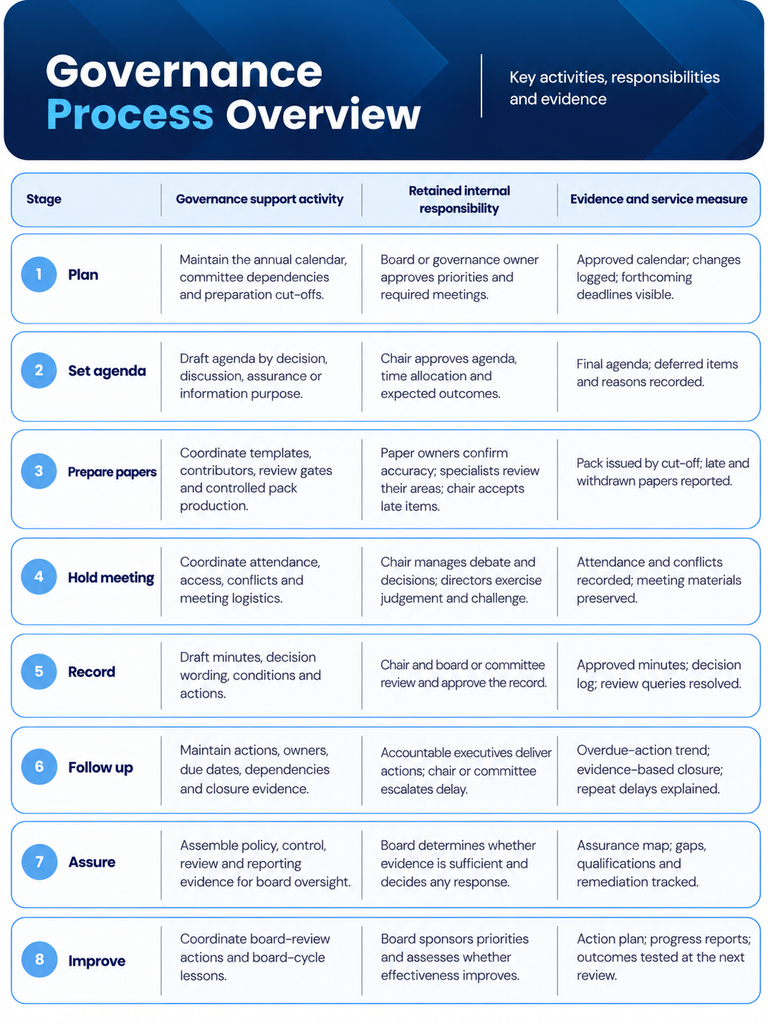
Build support around the board’s real decisions
Governance support is most valuable when it gives directors better control over their limited attention. The starting point is one complete board cycle: trace how an issue reaches the agenda, how the paper is reviewed, who decides, what is recorded and how the action is closed. That test will show whether the priority is clearer authority, stronger information, better meeting discipline or additional capacity.
We provides Company Secretarial and Governance Support to the funds and finance industry through outsourcing, specialist project support and professional secondments. Where the need is operational, the firm can support agreed governance processes within the client’s systems and controls. Directors and appropriately qualified advisers should continue to determine legal or regulatory obligations, formal appointments and substantive decisions.
Frequently asked questions
The scope may include governance calendars, agendas, board papers, meetings, minutes, action logs, policy registers, terms of reference, authority schedules, board information standards and review coordination. Confirm formal appointments, filings and specialist advice separately.
Consider it when growth, change, remediation, vacancies or recurring process failures exceed internal capacity. Diagnose whether the need is temporary project support, an ongoing co-sourced service, a professional secondment or a broader internal process change.
The authorised board, committee and internal owners retain their decision-making, oversight and applicable legal or regulatory responsibilities. They should approve scope, challenge outputs, decide exceptions and oversee the provider.
Provide the entity and committee structure, constitutions, terms of reference, calendar, reserved matters, delegations, policies, prior packs and minutes, action logs, filing obligations, systems, access rules, contacts and known open issues. Transfer should use an agreed inventory and acceptance checks.
Measure timeliness, completeness, first-time quality, late-paper rates, unresolved review points, overdue actions, repeat errors, stakeholder feedback, security incidents and remediation. Metrics should expose exceptions and outcomes, not simply count documents produced.
It can improve the operating conditions for effective governance by making information, decisions, records and actions more controlled. Effectiveness still depends on the chair, director contribution, management quality, culture and willingness to address difficult issues.