
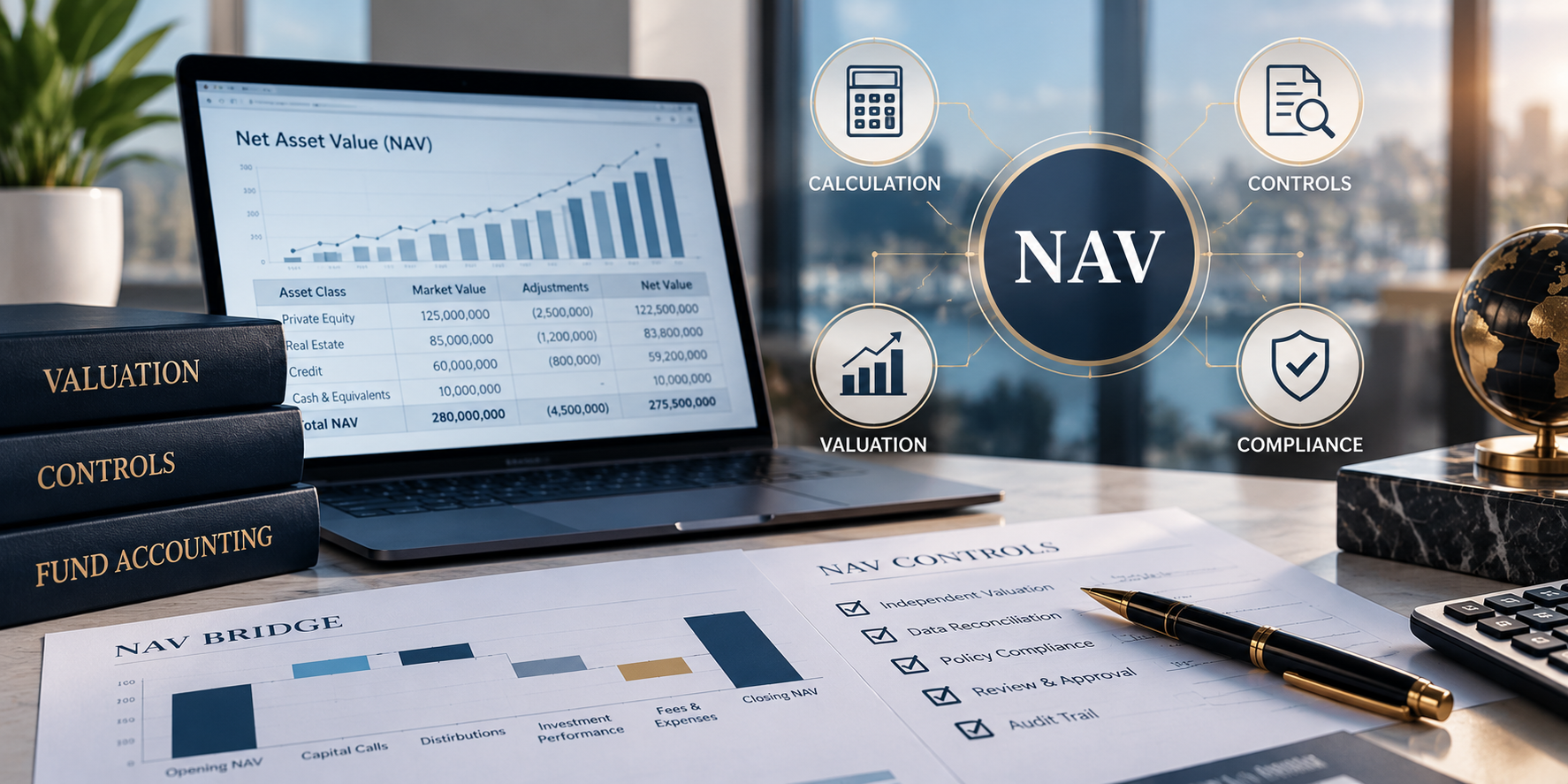
What Is Net Asset Value (NAV)?
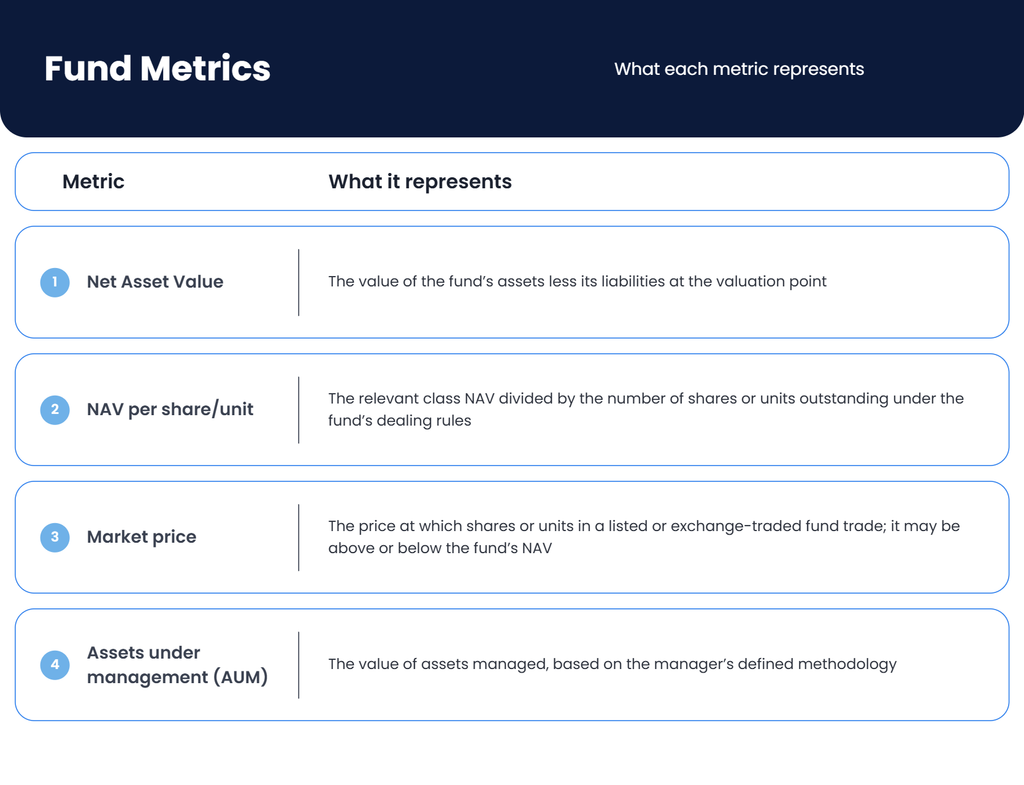
NAV is the value of a fund’s assets less its liabilities at a stated valuation point, calculated in accordance with the applicable valuation basis, governing documents and regulatory requirements. Where a fund has multiple share or unit classes, the relevant class NAV reflects the assets, liabilities, income, expenses and other adjustments allocated to that class. NAV per share or unit is then calculated using the number of shares or units outstanding under the fund’s dealing rules.
A fund’s dealing NAV may differ from the net assets reported in its financial statements where its governing documents prescribe a different valuation or pricing basis.
For experienced finance teams, the calculation itself is only the starting point. Reliable NAV reporting depends on control over valuation sources, cut-off, accruals, foreign exchange, investor activity and class-specific terms. Those inputs must align with the fund’s governing documents, accounting policies and reporting obligations.
NAV should also be distinguished from related measures:
Why NAV Matters in Fund Accounting
NAV is an operational control point as well as an accounting output. Errors can affect dealing prices, investor allocations, management and performance fees, financial statements and investor communications, so the focus is on the quality and traceability of the inputs rather than the arithmetic itself.
A robust process should evidence valuation decisions, reconciliations, exceptions, approvals and the version released, giving managers, boards, administrators and auditors a clear audit trail.
Where NAV Calculations Become Complex
Class-level NAVs can require allocations for different fee rates, hedging results, distributions, equalisation and issue terms. The denominator must reflect the shares or units validly outstanding after applying the fund’s dealing rules and cut-off procedures to subscriptions, redemptions, transfers and cancellations.
Complexity typically arises from class-specific fee structures, performance-fee crystallisation and high-water marks, equalisation, foreign-exchange hedging, illiquid or model-priced assets, corporate actions, late trade files and cut-off exceptions. These items can require judgement, iterative calculations or targeted review before release.
NAV Inputs That Require Judgement and Control
The main risk is completeness and appropriate treatment of inputs rather than identifying broad asset and liability categories. Teams should pay particular attention to valuation methodology, unsettled trades, income and expense accruals, fees, tax and derivative balances, borrowings, investor cash flows and any estimates used at the valuation point.
The NAV Control Workflow
Operationally, the workflow should be organised around independent evidence and exception management. Teams should source and validate holdings, trades, prices, cash and investor activity; apply approved valuation and foreign-exchange inputs; reconcile cash and positions; review class allocations and NAV movements; and resolve material exceptions before approval.
The retained audit trail should identify data versions, manual adjustments, reviewer evidence, cut-off decisions and the final report released so the valuation can be reconstructed.
How Often Is NAV Calculated?
Private equity, venture capital and real estate funds commonly determine formal NAVs at monthly, quarterly or other specified reporting dates, depending on their governing documents and applicable requirements. Their underlying investments may require more judgement because observable market prices are often unavailable.
The governing documents, valuation policy, investor terms, jurisdiction, regulatory obligations and reporting commitments should align. A fund should also define what happens when information is late, a market is disrupted or a valuation cannot be completed normally, including escalation, use of estimates and any correction or notification process.
Related Article: IPEV Guidelines For Private Capital Valuation
Common NAV Calculation Errors
Most NAV calculation errors originate upstream of the final equation. Recurring examples include:
Incorrect pricing: using a stale, inappropriate or unapproved price source, or applying the wrong foreign-exchange rate.
Missing or inaccurate accruals: omitting income, expenses, management fees or performance fees, or applying the wrong period or rate.
Cash or holdings breaks: unresolved differences between the ledger and bank, custodian, broker or portfolio records.
Valuation errors: misapplying a model, using outdated private-market inputs or failing to consider material information that should be reflected under the applicable valuation policy.
Timing and cut-off differences: recording trades, corporate actions, subscriptions, redemptions or expenses in the wrong valuation period.
Data and mapping issues: duplicate feeds, missing files, incorrect security identifiers, class allocation errors or uncontrolled spreadsheet changes.
A useful review of a NAV calculation error should document both the immediate correction and the process weakness that allowed it to pass. That assessment determines whether the remedy should address data ownership, system configuration, procedure design, review evidence or resourcing.
Controls That Support Accurate NAV Reporting
Effective fund accounting controls are designed around the risks in the valuation process. They should operate at the right time, produce evidence and assign a clear owner. Depending on the fund’s risks and asset classes, core controls may include independent price validation, cash and position reconciliations, reasonableness checks on NAV movements, tolerance-based exception reports, fee recalculation, review of manual journals, controlled data access and segregation between preparation and approval.
Materiality and tolerance thresholds help teams focus, but they should not become automatic permission to ignore recurring small breaks. Repeated differences can indicate a systemic cut-off, mapping or data-quality issue. An audit trail should show the source data, adjustments, exceptions, reviewer comments, approvals and final version released.
Project Accountants provides execution support for reconciliation, control and NAV reporting activity within clients’ existing systems and oversight frameworks. The work is structured to strengthen process discipline and supporting evidence while keeping accountability clear.
The Role of Fund Administrators and Accounting Teams
Responsibilities depend on the fund’s structure and applicable regulatory framework. An internal accounting team or fund administrator may collect data, maintain the books and records, apply approved prices and valuation methodologies, calculate accruals, prepare the NAV and produce reports. The fund manager, alternative investment fund manager, board, valuation committee or external valuer may have defined responsibilities for valuation decisions, oversight and approval. Depositaries, custodians and other parties may also perform separate oversight or verification functions.
Using fund administration support does not transfer every responsibility away from the regulated business. Roles, deadlines, data ownership, escalation paths and approval authority should be documented. Service-level reporting should distinguish completed controls from open exceptions so oversight is based on evidence rather than assumption.
When Should Funds Outsource NAV Calculation?
Specialist support can be useful during a fund launch, administrator or platform migration, changes in fund structures or asset classes, a compressed close, backlog remediation or preparation for audit. It can also help stabilise delivery when NAV volumes or reporting requirements change.
A fund may retain ownership and approval while using service providers for preparation, reconciliations, backlog remediation, shadow books or reporting support. A sound delivery model defines access, confidentiality, procedures, review standards, hand-offs and escalation before work begins.
Before outsourcing, assess the provider’s relevant fund experience, ability to work within existing systems, approach to exceptions and evidence, resilience around deadlines and clarity on accountability. The support should make the operating model more controlled and visible without introducing an opaque additional layer.
A Controlled NAV Process Supports Confidence
NAV is easy to express and difficult to produce well. Reliable reporting depends on appropriate valuations, complete accruals, reconciled records, disciplined cut-off, independent review and a clear evidence trail. Those elements give fund managers and oversight teams better visibility over both the reported result and the process behind it.
Where NAV delivery requires additional execution support, we can work within the existing operating model across investment fund accounting, reconciliations and investor reporting
Frequently Asked Questions
A NAV tolerance is a defined threshold used to direct review, escalation or correction activity. It should be set with reference to the fund’s valuation policy, dealing terms, materiality approach and applicable requirements. A result within tolerance still requires investigation where a recurring difference suggests a control or data-quality weakness.
The approved valuation policy should determine the alternative methodology, sources and governance required. Any model, proxy or estimate should be supported by current information, documented assumptions, appropriate challenge and approval, with escalation where uncertainty or potential impact is significant.
The fund should follow its documented error-correction and escalation process. This normally includes quantifying the impact on the fund, relevant classes and investors; assessing implications for dealing, fees and reporting; obtaining required approvals; correcting records; and communicating or compensating where the governing documents or applicable requirements call for it. The root cause and related control remediation should also be recorded.
Shadow NAV is an independent calculation or reconciliation benchmark maintained alongside the official NAV process. It can support oversight during administrator transitions, new fund launches, complex structural changes or periods of control remediation. Its scope, data sources, tolerance rules and treatment of differences should be defined so that the additional process produces clear evidence.
Fee rates, hedging results, equalisation, distributions and other class-specific items should be allocated using documented rules that are consistent with the fund terms and applicable accounting and valuation policies. Changes to assumptions or methods should be approved, applied consistently and supported by a clear audit trail.