

Outsourced compliance support gives financial-services businesses external capacity to perform defined compliance activities, such as monitoring tests, regulatory data preparation, policy maintenance, action tracking and board-report production. It can relieve capacity pressure and add specialist expertise, but it does not automatically transfer regulatory accountability, senior-management responsibilities or the governing body’s duty to oversee the business. The correct scope depends on the organisation’s sector, location, regulated status, permissions, risks and applicable rules.
Key takeaways
- Define the service by activities, outputs, owners and evidence, rather than using a broad label such as an “outsourced compliance function”.
- Retain internal authority for risk acceptance, policy approval, material judgements, regulatory decisions and oversight of the provider.
- Use co-sourcing where internal compliance knowledge is strong but capacity, specialist testing or project delivery is constrained.
- Give the provider controlled access to the information needed for the work, with confidentiality, data-protection, security and incident arrangements documented.
- Measure service quality through completed monitoring, evidence quality, overdue actions, reporting accuracy and escalation performance.
- Plan transition and exit before service commencement so that records, knowledge and critical activities remain available if the arrangement changes.
Why consider external support? Routine monitoring competes with remediation, regulatory change, board reporting, training and business-as-usual advice. External capacity can help when the operating model makes responsibility visible. Without clear ownership, however, duplicated tests, unowned findings and late reports can leave the board with activity data but little assurance.
This guide is for banks, investment businesses, fund managers and administrators, trust and corporate service providers, insurers, payments businesses, fintech firms and other regulated financial-services organisations operating in international and offshore markets. It is written for boards, directors, senior management, compliance and financial-crime officers, and operational leaders assessing outsourced compliance support. It first defines the model, then explains suitable activities and retained responsibilities, compares delivery options, and covers provider selection, implementation, oversight and exit. A responsibility matrix and decision checklist provide practical tools. Jurisdiction examples are grouped separately because terminology, approval routes and detailed requirements differ across the Channel Islands, the Isle of Man, Luxembourg, the wider EU, the UK, the US and other locations.
What outsourced compliance support means
Outsourced compliance support is an arrangement under which an external team performs agreed compliance work within the client’s governance, systems and control framework. It is best understood as controlled execution, not a transfer of accountability. The provider may supply recurring delivery, temporary capacity or specialist project support. The client remains responsible for defining the mandate, providing information, reviewing outputs, making reserved decisions and ensuring that the arrangement meets every applicable regulatory regime.
Express the scope as a service schedule, not a job title. It should state:
- The obligations, business areas and legal entities in scope.
- Each activity, frequency, method and expected output.
- Who prepares, reviews and approves the work.
- The information, systems and access required.
- The evidence to retain and its location.
- Thresholds for exceptions, breaches and urgent escalation.
- Dependencies and arrangements for change, incidents, absence, termination and record return.
This separates execution from authority. A provider may compile a board report, test a customer-file sample or maintain a regulatory calendar. The authorised client parties must determine whether the report is complete, approve the methodology, evaluate findings, confirm applicable obligations and decide the response.
“Outsourcing” has a formal meaning in some regulatory regimes. Document the classification before appointment and obtain specialist advice where it is uncertain.
Which activities can be supported externally?
Once the mandate is clear, the next question is which activities are suitable for external support. Many execution-heavy activities can be supported when the scope, access and review are appropriate. The examples below are common operating possibilities, not a statement that every activity may be outsourced in every jurisdiction.
Compliance monitoring
An external team may help translate the approved risk assessment and compliance monitoring plan into test scripts, request evidence, select samples, perform tests, maintain working papers, rate draft findings and track remediation. The internal compliance function should approve the plan and methodology, challenge the work, determine final ratings and report an accurate view to the board.
Testing needs more than a completed checklist. Each file should record the objective, population, sample method, evidence examined, exceptions, conclusion, reviewer and date. Findings should link to the relevant requirement and control. Where a provider identifies a potential breach or urgent weakness, the contract should require immediate escalation rather than waiting for the next reporting cycle.
Across jurisdictions, effective compliance monitoring is generally expected to be risk-based, evidence-led and subject to senior-management or governing-body oversight. The monitoring plan should reflect the firm’s activities, regulatory obligations and risk profile; testing should record its objective, method, evidence, exceptions and conclusion; and findings should drive tracked remediation. The relevant laws, rules, regulatory guidance and sector requirements must still be applied to each legal entity and location.
Regulatory reporting and records
Support may include maintaining an obligations calendar, coordinating inputs, validating data against source systems, preparing draft returns, retaining submission evidence and tracking regulator queries. The responsibility matrix should identify who confirms applicability, signs or approves the return, submits it and deals with corrections.
Data preparation should include control totals, source-to-return reconciliations and documented adjustments. If finance data feeds a regulatory return, compliance and finance owners should agree definitions and cut-offs. A provider should not make an entity-specific legal or classification judgement unless that work is within an appropriately authorised and approved scope.
Policies, procedures and regulatory change
External support can maintain a policy inventory, compare documents with approved requirements, coordinate updates and record approvals. It can also prepare change summaries, impact assessments and implementation trackers. Business owners and authorised specialists should decide how a regulatory change applies, approve the policy and accept any residual risk.
Policy wording should reflect the actual process. If a procedure specifies daily screening, independent review or an escalation deadline, the organisation must be able to evidence that activity. Updates should therefore be confirmed by the people who perform the control.
Financial-crime operations and remediation
Depending on the regime, support may include customer-risk data preparation, file remediation, quality checks, screening administration, training records and action tracking. Customer acceptance, suspicious activity, disclosures, sanctions treatment and statutory reporting remain with the authorised people required by that regime.
The FATF Recommendations, updated in June 2026, are international standards implemented through national frameworks. They support risk-based controls but do not replace the law, rules or guidance applying to the organisation.
Governance and board reporting
A provider may coordinate meeting inputs, prepare dashboards, maintain action logs and draft compliance reporting. The final report should distinguish completed work, limitations, overdue items, open findings, breaches, regulator contact and decisions required. Board minutes should record scrutiny, challenge, decisions and follow-up, rather than simply noting that a report was received.
Which responsibilities remain internal?
After identifying activities that may be supported externally, define the decisions and duties that stay inside the organisation. External support should not create an accountability gap. The organisation needs sufficient knowledge, access, authority and capacity to direct and oversee the work, understand findings, challenge the provider and respond if delivery fails.
The governing body and senior management should retain, subject to the applicable regime:
- Approval of the compliance framework, risk appetite, material policies and monitoring plan.
- Appointment and oversight of required compliance, financial-crime and other controlled-function holders.
- Decisions reserved by law, regulation, licence condition or governing documents.
- Essessment and acceptance of compliance risk and remediation priorities.
- Evaluation of breaches, notifications and engagement with regulators.
- Sufficient internal capability to interpret provider outputs and act on them.
- Oversight of service performance, conflicts, information security, continuity and exit.
Required compliance, financial-crime and other controlled-function holders retain the responsibilities assigned to their roles. Support staff may gather evidence, perform approved testing and prepare drafts, but the responsible officer or executive needs source access and enough time for independent judgement. Escalation must reach the appropriate officer, senior management or governing-body chair promptly.
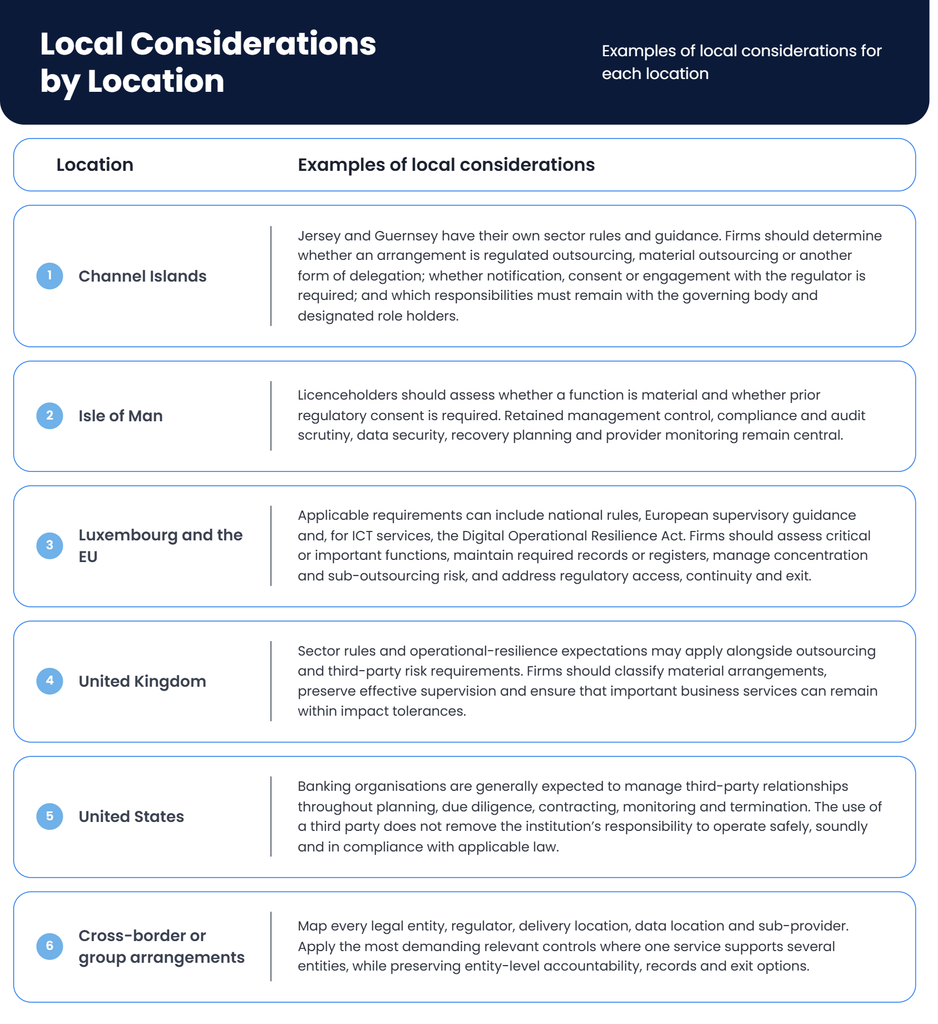
How requirements vary by jurisdiction
The core principles travel well: the regulated firm retains responsibility; the governing body needs adequate oversight and retained capability; higher-risk, material or critical arrangements require deeper due diligence and control; and contracts, access, audit, continuity, sub-contracting and exit need proportionate treatment. The detailed perimeter, terminology and notification or approval process must be checked for every entity and service.
Outsourced and co-sourced models compared
With activities and retained responsibilities defined, choose the delivery model. The choice is not limited to keeping everything in-house or transferring an entire workload: a defined model can combine internal ownership with external execution in different proportions.
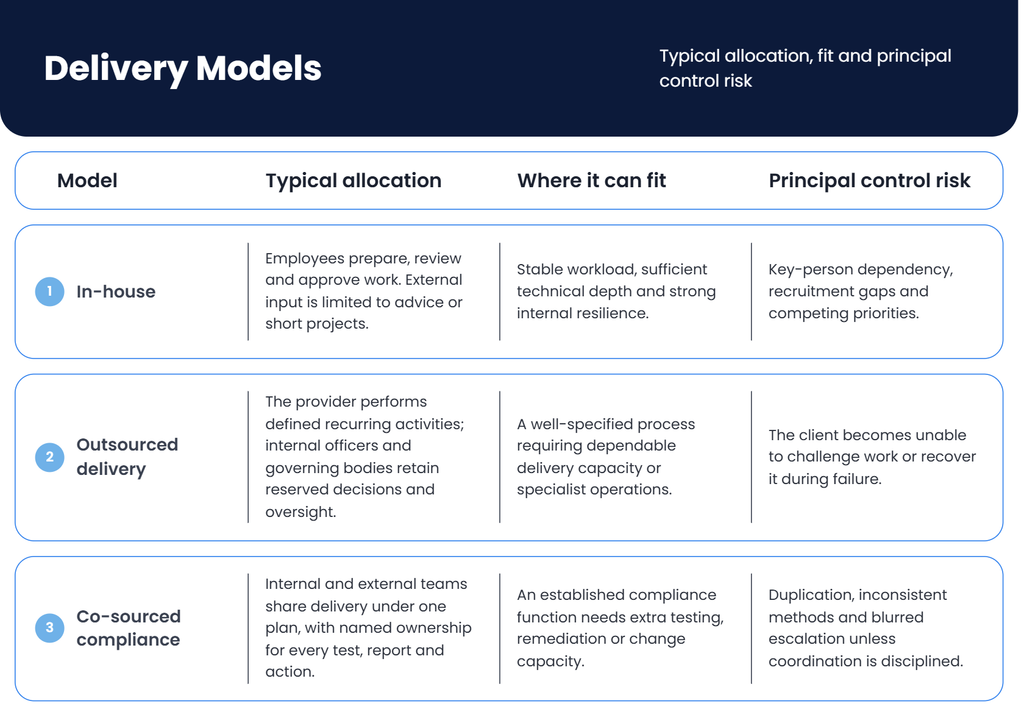
Co-sourcing can preserve internal knowledge of products, customers, risk decisions and regulator history while an external team performs agreed testing or project delivery. An internal owner should coordinate the plan, resolve conflicts and identify the authoritative version of each finding or report.
Fuller outsourcing still needs active oversight. The client should understand the provider’s methodology, staffing, systems, controls and limitations, and retain enough working-paper access and management information to identify deteriorating performance.
Controls, data and confidentiality
Compliance work can involve customer identity data, risk ratings, screening results, complaints, transactions, employee information, potential breaches and suspicious-activity information. Access should follow documented need, least privilege and segregation. Sensitive reports should not be stored in informal email chains or general shared folders simply because the provider is external.
The control design should cover:
- Named user access, multi-factor authentication and periodic recertification.
- Approved systems, secure transfer methods and restrictions on local downloads.
- Confidentiality obligations, conflicts and staff screening.
- Data location, retention, deletion and sub-processors.
- Change logs and reliable audit trails for tests, findings and reports.
- Incident identification, containment, notification and evidence preservation.
- Business continuity, recovery testing and alternative access.
- Return or secure deletion of information at exit.
Where a provider processes personal data, the client should determine whether the parties act as controller, processor, joint controllers or under another locally recognised status. Written terms should address documented instructions, confidentiality, security, individual-rights requests, breach assistance, sub-processors, audit, international transfers, retention and data return or deletion. The classification and required safeguards depend on the applicable privacy laws and on who determines the purposes and means of processing.
Legal privilege, tipping-off restrictions and protected disclosures may require additional controls. Identify restricted information, release authority and urgent routes, obtaining specialist advice where boundaries are uncertain.
How to select a compliance service provider
After choosing the model, select a provider against the operating requirement rather than its service catalogue. Give candidates a controlled description of the entities, permissions, customers, products, systems, risk profile, monitoring plan, reporting timetable, open remediation and expected change. Use confidentiality protections before sharing detailed files.
Evaluate the people who will deliver and review the service. Relevant questions include:
- Who are the service lead, reviewer and deputy, and where are they located?
- Which activities and jurisdictions are supported or excluded?
- How are regulatory changes approved and converted into work?
- How are samples, evidence, ratings and quality review controlled?
- What causes immediate escalation, including outside normal hours?
- Which systems, locations and sub-processors handle information?
- How are conflicts, staff changes, errors and disruption managed?
- What records and assistance are available at transition and exit?
Ask candidates to demonstrate a representative workflow using anonymised information. Evidence may include relevant references, role profiles, training records, information-security assurance, continuity tests, quality-review records and sample management information. Validate claims for the entity, team, systems and period relevant to the service.
Pricing should expose assumptions for implementation, recurring volumes, investigations, change, urgent requests, technology and exit. Check whether necessary review, meetings or routine changes are priced separately.
Implementation and ongoing oversight
Selection is only the start. A controlled implementation can be organised into six stages.
- Confirm applicability and governance. Determine whether the arrangement is regulated outsourcing, identify required notifications or approvals, name accountable owners and document reserved decisions.
- Baseline the service. Agree the obligation inventory, risk assessment, monitoring plan, open findings, reporting cycle, systems and records. Record limitations in the starting data rather than allowing them to emerge during testing.
- Build the responsibility matrix. Assign preparation, review, approval, consultation and notification for each activity. Include absence cover and urgent escalation.
- Transfer and validate. Use an inventory for policies, testing files, regulatory correspondence, calendars, data, actions and access. Both parties should confirm completeness and resolve rejected or missing items.
- Run a controlled first cycle. Test access, evidence standards, quality review, reporting, escalation and meetings before relying on the provider for a critical deadline. Reconcile the provider’s output to the agreed scope.
- Operate and improve. Review service measures, aged actions, changes, incidents and capacity at an agreed frequency. Reassess the scope when the business, risk profile, regulation, systems or provider team changes.
Management information should cover plan completion by risk category, timely tests, review rejections, open findings, overdue actions, repeat findings, reporting corrections, urgent escalations and provider staff changes. Each measure needs a definition, source, owner, threshold and response.
Oversight meetings should end with decisions and accountable actions. The client should sample provider work and retain evidence of challenge. After a control failure, preserve evidence, assess affected work, correct dependent reports and decide whether notification is required.
Exit and continuity planning
Exit planning starts before the contract is signed. The agreement should state who owns work products, where records are held, the formats available, how access will continue, which assistance is included and how sub-processors will be disengaged. It should address planned transfer, provider failure, loss of key staff, cyber incident and termination for cause.
Maintain an exit inventory covering policies, obligations, plans, working papers, findings, actions, board reports, correspondence, data dictionaries, calendars, credentials and process notes. Records should be retrievable without relying on one provider employee.
Continuity tests should cover a critical activity, such as producing a board report or regulatory return from recovered records. Record issues, decisions and remediation, then retest material failures.
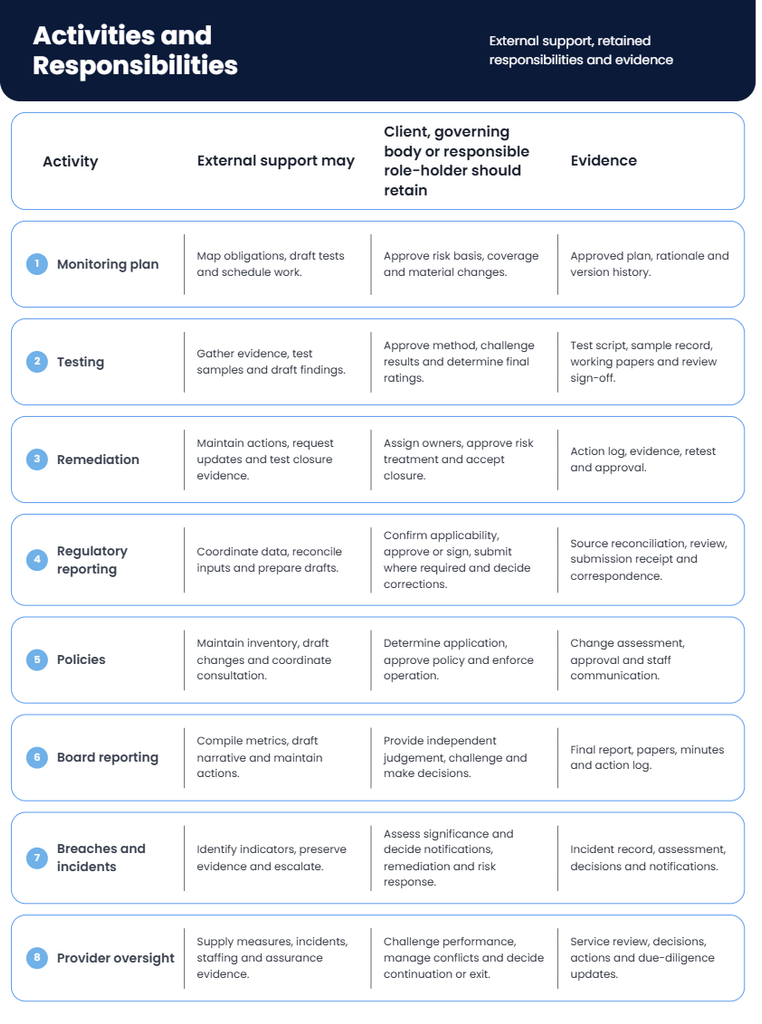
Retained vs outsourced compliance responsibility matrix
The matrix below is a starting point for governance design. It must be adapted to the organisation’s regulatory regime and appointments.
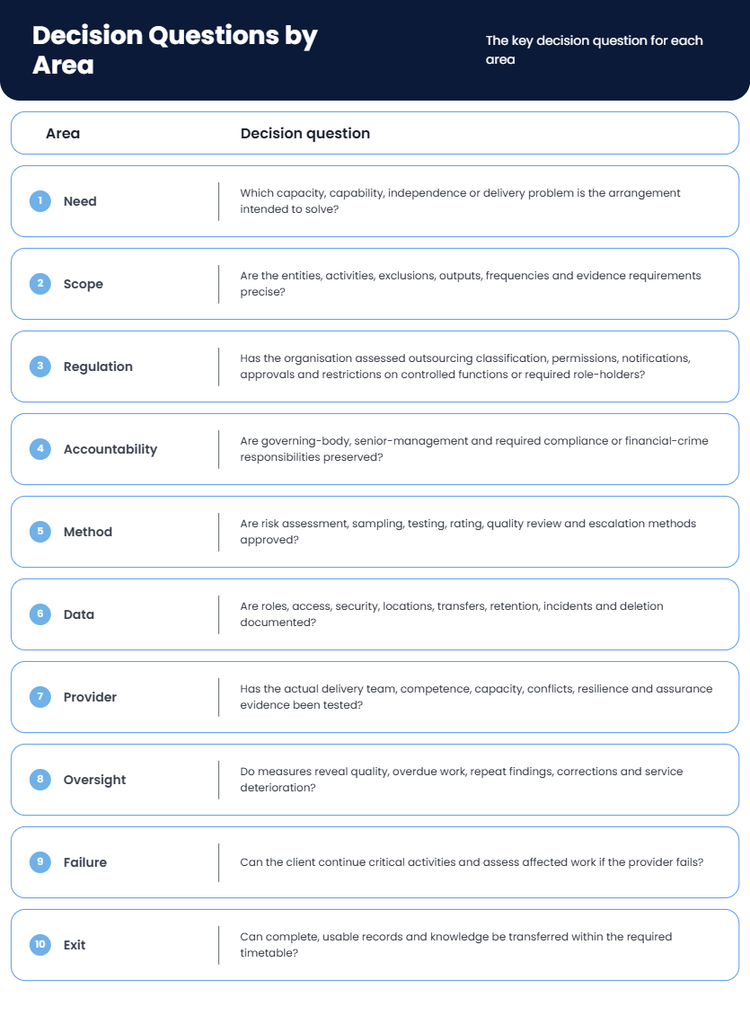
Practical decision checklist
Before approving outsourced compliance support, confirm that the answer to each question is documented.
Frequently asked questions
The scope can include monitoring tests, working papers, policy administration, regulatory data preparation, action tracking, governance reporting, training records and project remediation. The exact service should identify activities, owners, approvals, evidence and exclusions, and must fit the applicable regulatory regime.
Common triggers include monitoring backlogs, regulatory change, remediation, staff absence, growth, new systems, specialist testing needs or weak continuity. The case should define the control or capacity problem before a provider is selected.
The governing body, senior management and required role-holders retain the responsibilities assigned by applicable laws, regulations, licences, governing documents and internal mandates. These commonly include oversight, material judgement, risk acceptance, policy approval, regulatory engagement and decisions on breaches or notifications.
Yes. In a co-sourced model, internal and external teams share delivery under one plan, usually with internal compliance retaining close operational ownership. Fuller outsourcing allocates more recurring execution to the provider, but still requires retained client capability and oversight.
Assess the proposed delivery team, relevant competence, methodology, quality review, escalation, systems, data handling, conflicts, capacity, resilience, pricing and exit support. Test claims through a workflow demonstration and evidence relevant to the actual service.
The provider will usually need an entity and permissions map, obligation inventory, risk assessments, monitoring plans, policies, reporting calendars, open findings, regulatory correspondence, system details, data definitions and named owners. Transfer should use an inventory with validation and acceptance.
Use measures linked to outcomes: plan completion, evidence quality, review rejections, overdue actions, repeat findings, reporting corrections, urgent escalations, continuity and provider-team stability. Each measure should have a clear threshold and response.
A company may allocate substantial execution work to a provider, but it cannot assume that legal or regulatory accountability transfers with the work. The governing body, senior management and required role-holders must retain the authority, information and capability required in every applicable jurisdiction.
No. Outsourcing can change who performs an activity, but it does not automatically change who is accountable for oversight, material judgement, risk acceptance, approvals, breaches or regulatory engagement.
Outsourced compliance usually involves recurring delivery of defined activities under an agreed service schedule. Compliance consulting is more often advisory or project-based, such as interpreting a change, designing a framework or reviewing a control. An engagement can contain both, but the scope and decision rights should distinguish them.
Cost depends on scope, regulatory complexity, transaction or file volumes, service frequency, technology, senior review, urgent requests and transition needs. Compare proposals using the same assumptions and identify charges for implementation, investigations, change requests and exit support.
The timetable depends on regulatory approvals or notifications, scope complexity, data quality, system access, record transfer and the readiness of both teams. A controlled implementation should include due diligence, contracting, responsibility mapping, transfer validation and a tested first reporting cycle before full reliance.
The agreement should define activities, outputs, service levels, responsibilities, access, confidentiality, data protection, security, quality review, escalation, audit rights, continuity, sub-contracting, record ownership, regulatory access, change control and exit assistance.
Key risks include blurred accountability, weak provider challenge, poor evidence, data exposure, inconsistent methods, concentration or key-person dependency, missed escalation, service disruption and loss of records or knowledge at exit. Each risk should have a named control owner and evidence of oversight.
Operational performance should be reviewed at a frequency proportionate to risk and reporting deadlines, with prompt escalation for urgent issues. Formal due diligence and scope reviews should also occur periodically and when the business, regulation, systems, risk profile or provider team changes materially.