

Cost-efficient fund administration means securing the right scope, control environment and service capacity at a sustainable total cost. Fund managers should compare proposals on the same operational basis, including recurring fees, minimums, implementation charges, exceptions and exit support, before judging value.
A low headline fee can become expensive when a growing fund generates extra entities, investor activity, bespoke reporting or remediation work. The practical question for a board, CFO or COO is whether the operating model can deliver reliable accounting, administration and investor service as complexity changes.
Key takeaways
- Define the service scope and responsibilities before requesting prices.
- Normalise recurring, one-off, pass-through and out-of-scope charges.
- Assess controls, responsiveness, business continuity and capacity for growth alongside price.
- Identify the oversight responsibilities and regulatory requirements that apply to the arrangement, and plan for service failures and exit.
What fund administration covers
Fund administration may include fund accounting, capital calls and distributions, investor records, cash and position reconciliations, financial statements and investor reporting. Depending on the mandate, it may also include investor onboarding and agreed support with know-your-customer (KYC), anti-money-laundering (AML) and regulatory reporting. Responsibilities vary by fund structure, jurisdiction, provider and contract.
Compare the administrator’s charges separately from investment management fees, performance fees or carried interest, investment transaction costs and other fund expenses, while checking whether the proposal bundles additional services. Two providers may use the same service label while including materially different work.
How cost-efficient fund administration is priced
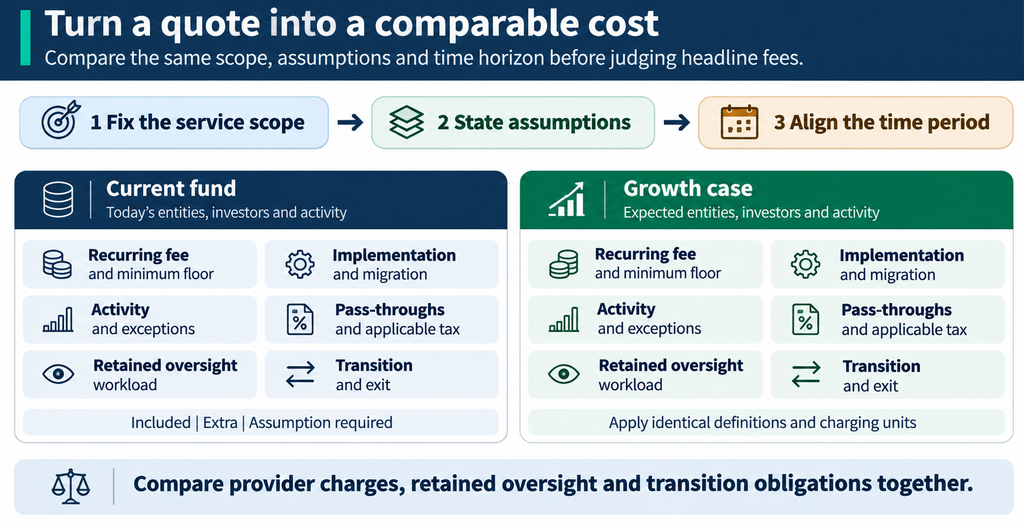
Fund administrators may charge a fixed annual fee, a percentage of an agreed asset or capital measure, fees per entity or activity, or a combination of these. An annual minimum often operates as a fee floor rather than an extra charge on top of the same percentage fee, so check the contract mechanics and avoid double counting. Tiered rates may also apply. Where a percentage fee is quoted, confirm the calculation basis, valuation dates and billing frequency. A rate applied to committed capital, meaning investors’ agreed funding commitments, is not directly comparable with the same rate applied to net asset value (NAV), broadly the fund’s assets less its liabilities. Model how each proposal changes after additional closes, new entities, more investors or higher
One-off items deserve their own schedule. Onboarding, implementation, migration, data cleansing, system integration, parallel running and termination or transition support may sit outside the recurring fee. Pass-through expenses and third-party costs should also be identified, with the approval process and any mark-up stated.
The main cost drivers are operational rather than cosmetic: fund and entity structure; asset class; committed capital or NAV; investor count; capital-call and transaction volume; valuation complexity; reporting frequency; jurisdictions; KYC and AML workload; data interfaces; bespoke investor reporting; service levels; and work outside the agreed scope. Ask providers to show which assumptions drive the quote, how the price changes when those assumptions move and whether the same definitions apply throughout the fund’s life.
Confirm which costs are payable by the fund, the manager or another entity, and check the proposed allocation against the fund documents and applicable requirements. A lower invoice to the manager does not necessarily mean a lower total cost to the fund.
Why the cheapest proposal may not deliver the best value
Cost efficiency depends on the consequences of delivery as well as the invoice. Late reporting, recurring reconciliation breaks, unclear data ownership or weak escalation can absorb management time and create avoidable remediation. A stronger proposal should show who prepares, reviews and approves each output; what evidence is retained; how exceptions are identified; and when issues reach the fund manager or board.
Service resilience also has a price. Assess key-person dependency, cybersecurity, business continuity, subcontracting, independent assurance where relevant, and the provider’s ability to support growth. For any assurance report, check the system and controls covered, reporting period, exceptions and user-entity controls rather than relying on the report title alone. The contract should explain incident notification, remediation ownership, service credits or other remedies, and the support available if performance deteriorates or the relationship ends.
How to compare fund administrator proposals
Use a common requirements schedule and make each bidder respond against it. The following six checks create a more reliable comparison:
- Define scope and ownership. List activities, entities, systems, data inputs, reporting dates and responsible parties. Record who prepares, reviews and approves each key deliverable.
- Normalise the price. Separate recurring fees and minimum-floor mechanics from setup and migration costs, pass-through expenses, applicable taxes and out-of-scope rates. Model at least the current state and a realistic growth case over the same period.
- Test relevant capability. Check any authorisation or registration required for the proposed services and jurisdiction, alongside experience with the fund type, asset class, reporting obligations and investor needs. Confirm the proposed team’s experience, availability and supervision arrangements.
- Review controls and evidence. Understand reconciliations, review thresholds, access controls, data ownership, cybersecurity, exception logs, retained records and any relevant independent assurance.
- Evaluate service delivery. Agree reporting calendars, response and resolution targets, escalation routes, change control, implementation resources and management information for ongoing oversight.
- Plan for change and exit. Confirm pricing reviews, contract terms, data portability, termination charges, handover obligations, parallel running and contingency arrangements if service fails.
When outsourcing or co-sourcing can be cost-effective
Outsourcing may suit a recurring workload that requires dedicated delivery capacity. Co-sourcing, project support or secondments may suit teams that retain internal processes and systems but need additional people or specialist experience. Compare each option with the full cost of internal delivery, including recruitment, systems, supervision, review and business continuity. Define the client’s oversight and approval responsibilities for each model. For a regulated business, outsourcing does not by itself transfer regulatory accountability; the applicable rules depend on the entity, activity and jurisdiction.
We provides agreed fund accounting, reporting and operational support through Fund Administration Support, co-sourcing, specialist projects and professional secondments. Where required, our teams work within clients’ systems, procedures and control frameworks, with preparation, review and approval responsibilities agreed for each engagement. We not a regulated fund administrator, alternative investment fund manager or depositary; the regulated business retains responsibility, oversight and control.
Before comparing another quote, define the fund accounting, reporting and administration work you need delivered.
There is no reliable universal price for fund administration. Cost depends on the agreed scope, charging basis, fund and entity structure, investor numbers, transaction volume, valuation and reporting complexity, jurisdictions, interface and exceptions. Compare written proposals using the same assumptions, charging units and time horizon.
Typical scopes may include fund accounting, reconciliations, capital activity, investor records and agreed reporting. Inclusion varies by provider and mandate, so the proposal should list deliverables, assumptions, exclusions, pass-through expenses and one-off work.
Standardise data and reporting, reduce avoidable manual exceptions, set clear cut-off times, remove duplicate work and use volume forecasts to negotiate appropriate tiers. Preserve preparation, review, approval, evidence and escalation controls when redesigning the process.
Outsourced fund administration can be cost-effective when the agreed service meets the fund’s operational needs at a competitive total cost compared with internal delivery. Include implementation, client oversight, additional charges and exit costs in the comparison, alongside the provider’s expertise, controls and service capacity.