

Fund reconciliations compare a fund’s accounting records with relevant external records or other controlled records, depending on the purpose of the check. Differences are investigated, supported by evidence and reviewed, with corrections or documented follow-up where needed. These controls support net asset value (NAV) calculations, investor reporting and financial statements.
Matching records is only one part of the process. Closes slow when files arrive at different cut-offs, identifiers do not align, ownership is unclear or old breaks are carried forward without resolution.
This global guide is for fund CFOs, COOs, controllers and operations leaders. It explains what to reconcile, how to clear breaks, where review belongs and how to oversee outsourced execution. Requirements vary by fund, reporting framework and jurisdiction.
Key takeaways
- A reconciliation can be signed off with outstanding items only where the applicable procedures permit this; their impact has been assessed, and the required review or approval is documented. Outstanding items remain tracked until resolved.
- Frequency, tolerance, and escalation should reflect the risk of each balance or transaction of population, subject to applicable regulatory requirements and contractual obligations.
- Named preparation, review, approval and exception ownership remain essential, including when execution is outsourced.
- Automation can accelerate matching, but controlled rules, data lineage and a visible exception queue matter more than the headline match rate.
What fund reconciliations are
A fund reconciliation compares balances or transactions at a specified date or over a defined period. Depending on its purpose, it may use bank statements, custodian or broker records, administrator reports, investor registers, loan schedules or controlled internal records. The records must cover the same legal entity, account, currency and relevant period, with differences in cut-off or accounting basis identified. Internal comparisons test consistency; they do not provide the same independent corroboration as suitable external evidence.
The control should name the assertion being tested. Agreement between position records does not, by itself, establish legal ownership or confirm that assets are properly safeguarded. Those matters require evidence and controls appropriate to the asset and holding structure. A single “complete” status cannot demonstrate that each risk has been addressed.
Reconciliation is distinct from valuation: agreement between systems does not prove that an investment is measured appropriately if both use the same incorrect input. IOSCO’s June 2026 Recommendations on Valuing Collective Investment Schemes provide updated guidance on fund valuation practices. Reconciliations support checks on recorded information; they do not replace the applicable valuation policies, methodologies or governance.
Why reconciliations matter to NAV and reporting
NAV is the value of a fund’s assets less its liabilities at the relevant valuation point. Its calculation depends on accurate investment valuations, cash balances, receivables, accruals and other liabilities, with foreign-currency amounts translated on the applicable basis. Capital activity also affects net assets and investor or share-class allocations. A reconciliation difference may affect NAV, dealing prices, investor reporting or financial statements, so its potential impact should be assessed before the relevant output is approved.
Liquid portfolios bring high volumes, short settlement cycles, corporate actions and pricing risks. Private-market records are more dispersed across capital calls, loan schedules, portfolio companies, valuation models and entity ledgers. Both require control over ownership, cash, debt, accruals and investor activity.
A reviewer should be able to trace the sources, parameters, unmatched population, explanations, evidence, corrections, approvals and sign-off. This supports management oversight and audit enquiries. Records should be retained in accordance with applicable legal and regulatory requirements, relevant contractual obligations and the organisation’s documented retention policy.
Requirements depend on the entity, fund and jurisdiction. For example, Article 86 of Commission Delegated Regulation (EU) No 231/2013 requires an in-scope AIF depositary to reconcile all cash-flow movements daily or, where movements are infrequent, when they occur. It also requires a full review of the reconciliation process at least annually. Separately, FCA COLL 6.3 addresses valuation and pricing for UK authorised funds, including specific accounting and NAV requirements for UCITS schemes. These requirements should be applied only within their respective scope.
Types of fund reconciliations
The inventory should reflect the fund’s structure, instruments and reporting outputs. Common categories include:
Cash: bank, custodian and prime-broker balances; receipts and payments; investor cash; capital calls and distributions; restricted cash and cash in transit.
Investments and positions: quantities, asset identifiers, recorded holdings, cost, commitments, unfunded amounts and custody or holding details, using relevant custodian records, private-asset registers and loan schedules. Legal ownership requires appropriate supporting evidence beyond agreement between records.
- Transactions: trades, settlements, acquisitions, disposals, drawdowns, repayments, transfers and corporate actions.
- Income, expenses and accruals: interest, dividends, fees, performance allocations, operating expenses, withholding and expense caps, where applicable. Tax treatment requires qualified advice.
- Investor and capital activity: commitments, contributions, distributions, units or shares, investor allocations and registry records.
- Financing, derivatives and collateral: principal, interest, margin, collateral, counterparty valuations and cash flows.
- NAV and share classes: trial balance to NAV pack, class allocations, fees, FX, NAV movement and administrator-to-manager comparison.
Cadence should reflect transaction volume, dealing and valuation frequency, liquidity, source availability, contractual deadlines and correction time. A closed-ended fund with monthly reporting may need prompt cash controls around capital events; a daily-dealing fund may require daily cash, position and NAV checks.
An end-to-end fund reconciliation process
A repeatable process separates data preparation from the decisions needed to clear exceptions:
Scope and schedule: Maintain an inventory of funds, entities, accounts, instruments, currencies, sources, owners, frequencies, tolerances and deadlines. Add new accounts and products through change control.
Acquire and validate data: Use controlled systems or approved providers. Record the valuation date, file time, timezone, basis, version and completeness checks; retain reproducible inputs.
Standardise and map: Align entity, account, instrument identifier, currency, sign convention and cut-off. Approve and log mapping changes.
Match records: Apply approved exact and tolerance rules without hiding aggregation. Separate matches, expected timing items and unexplained exceptions. Matching tolerances must not be treated as automatic permission to leave accounting errors uncorrected.
Triage exceptions: Classify breaks by type, age, value, reporting impact, liquidity or dealing relevance and owner. Do not use materiality to discard recurring or control-significant items.
Investigate and resolve: Trace the break to evidence and correct the appropriate source through an authorised entry or data fix. For timing items, record the expected clearing event and date.
Review and approve: An independent reviewer challenges inputs, rules, explanations and corrections. Escalate material judgements or unresolved impacts before NAV or reporting release.
Close and learn: Retain sign-off and evidence, monitor aged and recurring breaks, and address root causes. Report overdue controls and unresolved exposure.
Investigating and clearing reconciliation breaks
A break is a difference requiring explanation, not automatically an error. An expected timing item still needs evidence appropriate to its cause, a named owner and an expected clearing date. A “timing” label alone is insufficient, and the item should remain tracked until it clears.
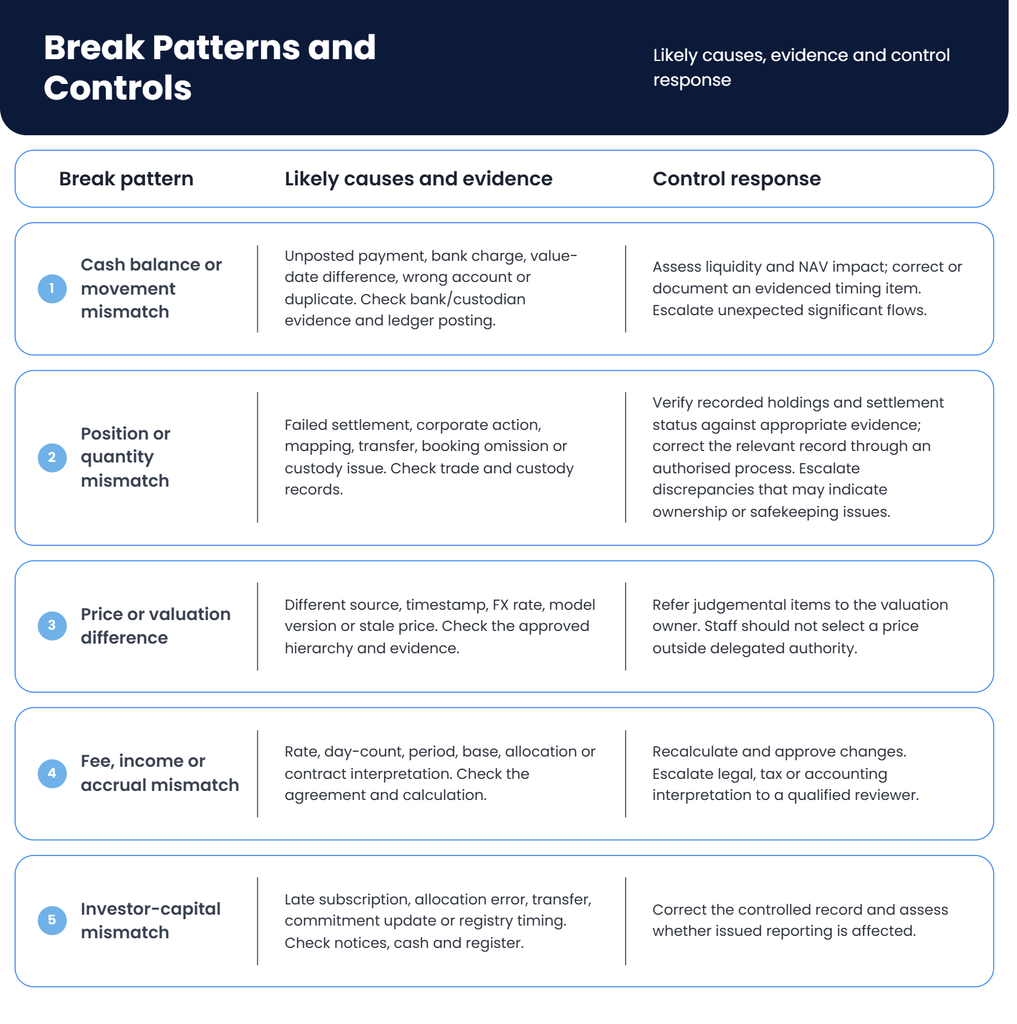
Age a break from when it arose, not when its comment was last edited, and track recurrence. Small repeated differences may expose a defective interface, mapping or hand-off. Netting unrelated breaks, using suspense accounts without investigation or carrying forward unsupported explanations can conceal unresolved issues.
When a reconciliation control fails, do not rely on its completion status as evidence that the relevant balances are accurate. Preserve the available evidence, assess the potential NAV or reporting impact, notify the responsible owner and apply the agreed contingency procedures. The authorised decision-maker should determine whether alternative checks are sufficient or release must be delayed, and document the decision and approval.
Roles and review controls
Responsibility should be explicit: the preparer obtains and matches data; the break owner investigates; the reviewer challenges the work and evidence; and the accountable manager approves material judgements, unresolved exposure or release decisions. Segregation is especially important where one person can initiate cash, post entries and prepare the control.
Fund controllers or finance leads often own the close, while administrators, operations, treasury, investment teams, valuation specialists, transfer agents and portfolio companies supply records or resolve items. Name deputies and escalation routes. Thresholds should consider value, NAV impact, age, unusual activity and control significance.
Review evidence should confirm population completeness, source suitability, totals, matching rules, aged-item challenge, authorised corrections and final status.
In Jersey, the JFSC Fund Services Business Code of Practice includes requirements for robust systems and controls, authorisation and orderly records for registered persons within scope. It is a Jersey-specific example, not a universal control or retention rule.
Technology and data lineage
Technology should shorten the path from source data to a reviewed exception while preserving explainability. Useful capabilities include direct feeds, controlled mapping, configurable rules, workflow ownership, ageing, evidence attachment, approval history and reporting by fund, account and break type.
A high auto-match rate does not prove control quality: broad tolerances, aggregation and stale mappings can weaken detection. Govern rule approvals, access, changes, interface completeness, rejected records, duplicates and reperformance. Spreadsheets may suit lower volumes if access controlled, versioned, protected, reviewed and backed up.
Data lineage links the original transaction or position to the ledger, reconciliation, NAV pack and report, helping locate failures in capture, mapping, accounting, valuation or reporting. Standardise data before automating stable rules; retain human review for ambiguous events and policy exceptions.
Outsourcing reconciliation support
Fund accounting outsourcing can cover ongoing reconciliation delivery, reporting peaks, administrator transitions or the investigation and clearance of aged breaks. Define the entities, accounts, reconciliation types, deliverables, systems, authority to make corrections and review responsibilities. Service levels should cover input deadlines, completion, escalation and the resolution of outstanding items.
The client should retain enough knowledge and access to challenge the work. Oversight should cover missing inputs, unreconciled exposure, ageing, recurring causes, adjustments and incidents. Agreements should address confidentiality, access, change, continuity, record return, exit support and tested contingencies.
Where the JFSC Outsourcing Policy applies, the business remains accountable for outsourced activity. The policy addresses provider suitability, written agreements, ongoing monitoring and contingency planning. Unless an exception applies, the business must notify the JFSC before appointing the provider, and the outsourced activity must not begin until a No Objection has been received.
We supports fund managers, fund administrators and finance teams through fund accounting, fund administration support and operational finance outsourcing. We take responsibility for delivery within an agreed scope, working in the client’s systems and control framework. Preparation, review, corrections and escalation responsibilities are defined for each engagement, while the client retains its applicable legal and regulatory responsibilities.
A practical fund reconciliation control checklist
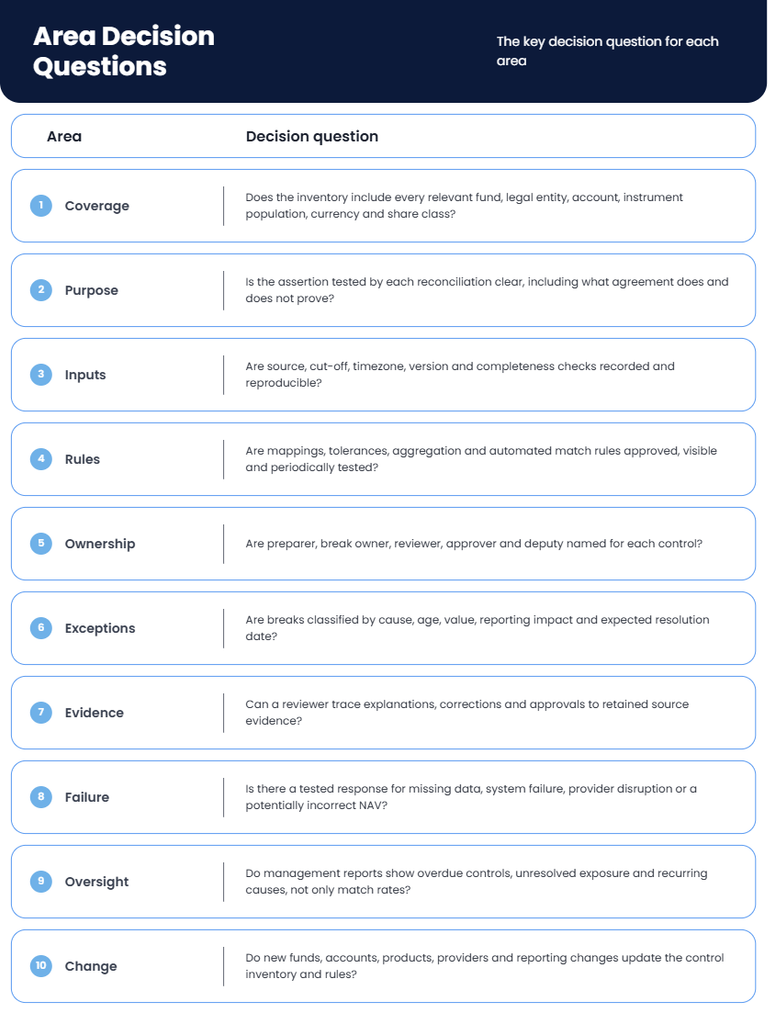
Use these questions before the next close. Each “no” should produce a named action, owner and date.
Frequently asked questions
No. A difference may arise from settlement timing, different reporting cut-offs or transactions recorded in one system before another. Each break should be investigated and supported by evidence to determine whether a correction is needed.
In some circumstances, yes. Outstanding breaks must be assessed for their potential effect on NAV and investor dealing, with release permitted under the applicable requirements and approved procedures. Any release decision should be documented by the authorised approver, and unresolved items must remain tracked.
The starting point is the agreed scope, relevant accounting records, supporting statements or reports, existing reconciliation files and outstanding-break logs. System access, deadlines, review responsibilities and authority to make corrections should also be agreed before work begins.