

A buyer’s guide for finance leaders across fund managers, administrators, family offices and fiduciary businesses
For funds and finance organisations, choosing a finance outsourcing partner starts with a clear outcome, scope and division of responsibilities. Then test each provider’s relevant experience, review controls, security, systems fit, governance, resilience, pricing, transition plan and exit arrangements using evidence rather than sales claims.
Key takeaways
- Define the business problem, scope, owners and measures of success before approaching providers.
- Assess operational fit, control and total cost, rather than comparing headline rates alone.
- Ask for evidence of review quality, access control, continuity, service governance and issue handling.
- Keep strategy, material judgements, key approvals, governance and accountability with the appropriate internal owners.
- Pilot a contained process before scaling, and agree the exit arrangements before work begins.
What a finance outsourcing partner does
A finance outsourcing partner takes responsibility for agreed finance processes or deliverables under a defined service model. The work may include repeatable operational finance activities, accounting support, reporting preparation, reconciliations, workpaper production or project-based execution. The client still needs clear ownership, review and approval arrangements.
The delivery model matters because several terms are often used loosely. For this guide, outsourcing means assigning an agreed process or output to an external provider. Regulatory definitions and requirements vary by jurisdiction, firm and activity. Co-sourcing combines an external team with the client’s own team under shared workflows and governance. A professional secondment places an individual within the client’s organisation for a period, while the client directs the day-to-day work. Offshoring describes where work is performed; it does not, by itself, describe who owns the process or how the service is governed.
These models solve different problems. A stable, documented accounting or administration process may suit outsourcing. A complex fund, entity or reporting workstream that depends on frequent internal judgement may suit co-sourcing. A temporary vacancy, peak reporting period or defined capacity gap may be better addressed through a secondment.
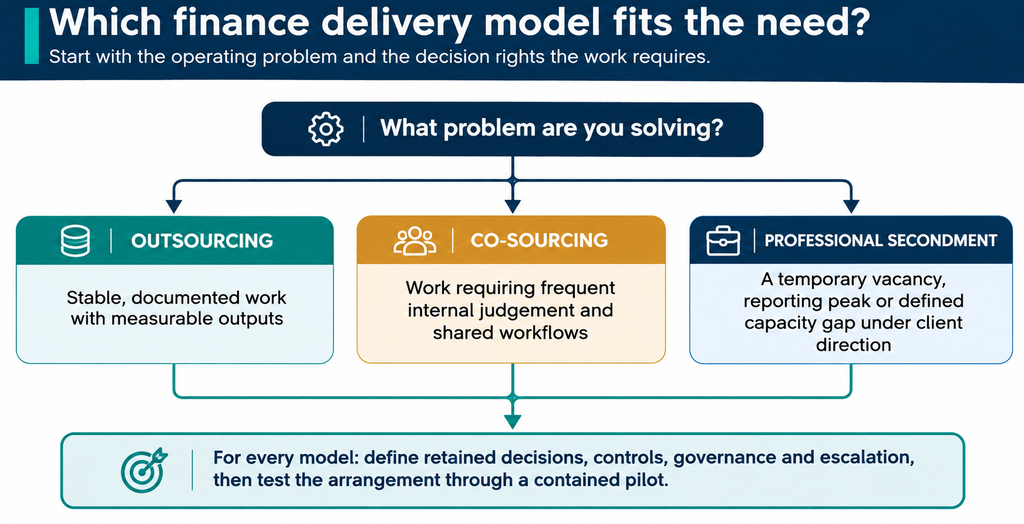
Start with the problem and target operating model
A provider shortlist is useful only after the organisation has decided what needs to change. A fund manager, administrator, family office, fiduciary business or finance team may need more capacity during close, stronger reporting discipline, specialist fund knowledge, better continuity, project support or a more flexible cost base. Each objective leads to a different scope, delivery model and evaluation.
Write a short requirements statement that answers five questions:
- What outcome should improve, and what evidence will show that it has improved?
- Which processes, entities, systems, reporting cycles and jurisdictions are in scope?
- Which tasks will the provider prepare, review or coordinate, and which decisions remain internal?
- What volumes, deadlines, dependencies, peak periods and known exceptions must the service handle?
- What should the steady-state service look like, including governance, escalation and retained client oversight?
This work exposes hidden assumptions early. For example, a proposal for monthly fund or entity reconciliations can look complete while excluding investigation of aged differences, evidence retention or escalation before investor, board or financial reporting deadlines. Precise process boundaries make provider proposals comparable.
Decide what to outsource and what to keep in house
Map each process by repeatability, judgement, risk, data sensitivity, dependency and control ownership. Documented reconciliations, reporting preparation, entity accounting support and other repeatable work with measurable outputs are usually easier to transition. Processes with frequent exceptions can still be outsourced, but only when decision rights and escalation routes are explicit.
The appropriate internal owners should generally retain:
- Finance strategy, policy choices and the target operating model
- Material accounting, valuation, classification and regulatory judgements
- Banking authorities, payment release and other key approvals
- Ownership of the control framework and acceptance of residual risk
- Governance, oversight of the provider and accountability to boards, regulators, auditors and stakeholders
Retaining accountability does not mean repeating the provider’s work. It means designing proportionate review, receiving useful management information and intervening when an exception exceeds an agreed threshold. For UK FCA-regulated firms, the FCA states that firms remain responsible and accountable for the regulatory responsibilities that apply to outsourcing and third-party arrangements. The precise requirements depend on the firm and the function, so regulated organisations should confirm the applicable rules before contracting.
For Jersey businesses within scope of the JFSC Outsourcing Policy, the governing body remains responsible and accountable for outsourced activity. The policy has a defined scope and specified exclusions; where it applies, notification and, in many cases, a JFSC No Objection are required before the activity begins. Firms should check the current policy and the treatment of the particular activity before appointment.
How to evaluate a finance outsourcing partner
1. Assess relevant finance and industry experience
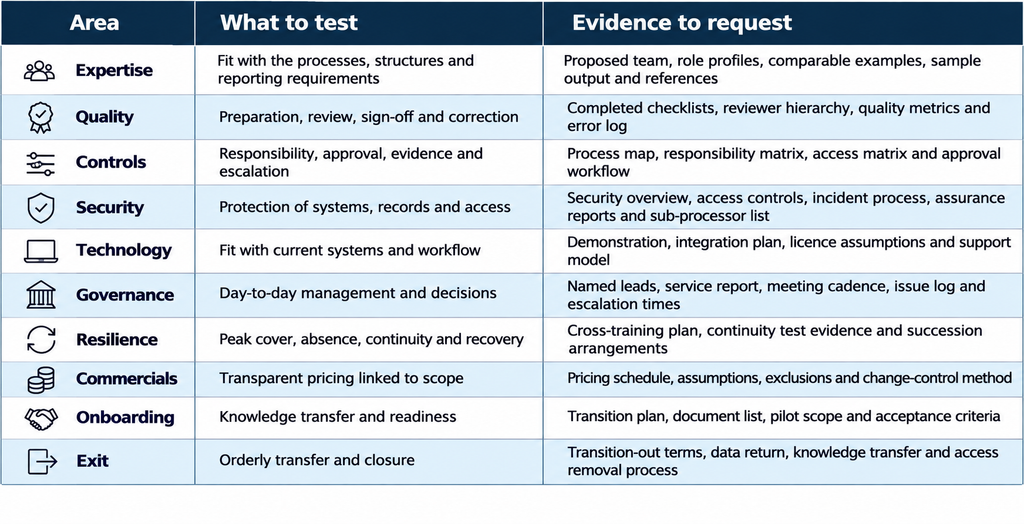
Look for experience that matches the proposed work: similar fund or entity structures, accounting processes, reporting calendars, systems, transaction volumes and operating constraints. For fund managers, administrators, family offices and fiduciary businesses, relevant sector knowledge should help the team understand dependencies and exceptions. Broad financial-services credentials do not prove that the proposed team can deliver the specific scope.
Ask for the proposed team structure, role profiles, relevant examples, sample deliverables and references for comparable work. Confirm who will perform the work after onboarding and how changes to the team will be managed.
2. Test review quality and control discipline
A credible provider should explain how work moves from preparation to review, approval and delivery. Ask who performs each control, what evidence is retained, how exceptions are logged, when issues are escalated and how recurring errors are analysed.
Request a sample process map, responsibility matrix, checklist, workpaper and quality report. Review whether the evidence shows clear preparer and reviewer roles, version control, sign-off, ageing of open items and corrective action. A policy document is useful, but completed examples reveal how the process operates.
3. Review security and access management
Finance providers may handle confidential records, personal data and privileged system access. Security due diligence should reflect the sensitivity of the information and the operational impact of a disruption. The assessment should cover least-privilege access, authentication, controls for granting, changing and removing access when staff join, change roles or leave, encryption, secure transfer and storage, logging, backups, incident response, staff training, locations and sub-processors.
Ask the provider to describe its technology supply chain as well as its own controls. NIST’s 2026 supplier due-diligence guide is written for ICT suppliers, but its focus on resilience, foundational cyber practices and supply-chain tiers provides a useful reference for questions about the systems that support a finance service. Legal and security specialists should confirm the requirements that apply to the client’s data, jurisdictions and regulated activities.
4. Check systems and workflow compatibility
Establish whether the provider can work with your fund accounting platform or ledger, entity structures, reporting tools, document standards, chart of accounts, workflow and close calendar. A parallel process can create extra reconciliations, duplicate data and unclear ownership.
Use a short demonstration based on a representative task. Test data transfer, approvals, evidence retention, status visibility and exception handling. Record any integration, licence, configuration or change-management work, including who pays for it and who maintains it.
5. Evaluate communication and service governance
Good communication is a designed operating process. Agree a named service lead, operational contacts, meeting cadence, status format, issue log, escalation route and decision rights. Define when an issue becomes an incident, who must be informed and how quickly the provider should present a recovery plan.
Ask to see a sample service report. It should make overdue work, unresolved exceptions, rework, control failures and decisions visible, rather than presenting activity counts without context.
6. Test capacity resilience and continuity
A provider must be able to absorb predictable peaks without weakening review. For funds and complex finance teams, those peaks may follow reporting cycles, capital activity, transactions, audits or entity growth. Ask how the provider forecasts demand, cross-trains staff, covers absence, manages succession and recovers from disruption. Test both scale-up and scale-down arrangements so the service can change without creating unnecessary cost or dependency.
Request the continuity plan for the service, evidence of recent testing and the recovery assumptions that apply to your work. Confirm whether critical knowledge sits with one individual and how quickly a replacement could become effective.
7. Compare total cost and commercial clarity
Compare the total operating cost of each proposal. Include transition work, licences, retained management time, internal review, expected rework, change requests, travel where relevant and the cost of maintaining duplicate processes. A lower rate can be poor value if the scope is narrow or the client must correct and coordinate the work.
Require a clear pricing basis, volume assumptions, inclusions, exclusions, indexation, minimum commitments and change-control method. Where relevant, test the effect of changes in entity count, transaction volume, reporting frequency and exception levels. Model a normal month, a peak period and an out-of-scope event to see how charges behave.
8. Examine onboarding and knowledge transfer
The onboarding plan should identify process owners, dependencies, access requirements, documents, training, shadowing, testing, acceptance criteria and the date on which responsibility changes. Knowledge transfer should produce usable process documentation, not rely on calls and individual memory.
Ask who owns each transition task and how readiness will be assessed. A provider that cannot explain its transition method is likely to underestimate the effort required from the client.
9. Review contract service levels and exit
The contract and service schedule should translate the operating model into responsibilities, deliverables, service levels, dependencies and remedies. Define data ownership, confidentiality, permitted locations and sub-processors, audit and assurance rights, incident obligations, record retention, access removal and end-of-contract data return or deletion as applicable.
Plan the exit before signing. Agree transition support, documentation standards, knowledge transfer, data formats, access closure, final reconciliations and charges. Legal, data protection, information security and regulatory specialists should review the terms for the relevant jurisdictions and activities.
Finance outsourcing due diligence matrix
Before comparing providers, review the available service options. We are specialist firm supporting the funds and finance industry. It helps clients address operational, accounting and compliance challenges through outsourcing, specialist project support and professional secondments. A scoping conversation can map the current workload, retained controls and suitable delivery model before a provider evaluation begins. See Project Accountants’ services.
Run a contained pilot before scaling
A pilot should test the operating model, not postpone difficult decisions. Choose a contained process with representative systems, deadlines and exceptions, such as one reconciliation class, entity group or reporting cycle. Avoid a scope so simple that it proves little or so critical that the organisation cannot tolerate a learning period.
A useful pilot includes:
- A written scope, baseline volumes and named client and provider owners.
- Documented procedures, inputs, outputs, review points and escalation thresholds.
- Controlled access setup, training, shadowing and parallel checks where proportionate.
- Success criteria for accuracy, timeliness, rework, communication and control evidence.
- An issue log, root-cause actions and a formal decision to scale, extend, redesign or stop.
Do not scale solely because deadlines were met. Review the quality of evidence, the amount of client intervention, the provider’s response to exceptions and whether the service can remain effective at higher volume.
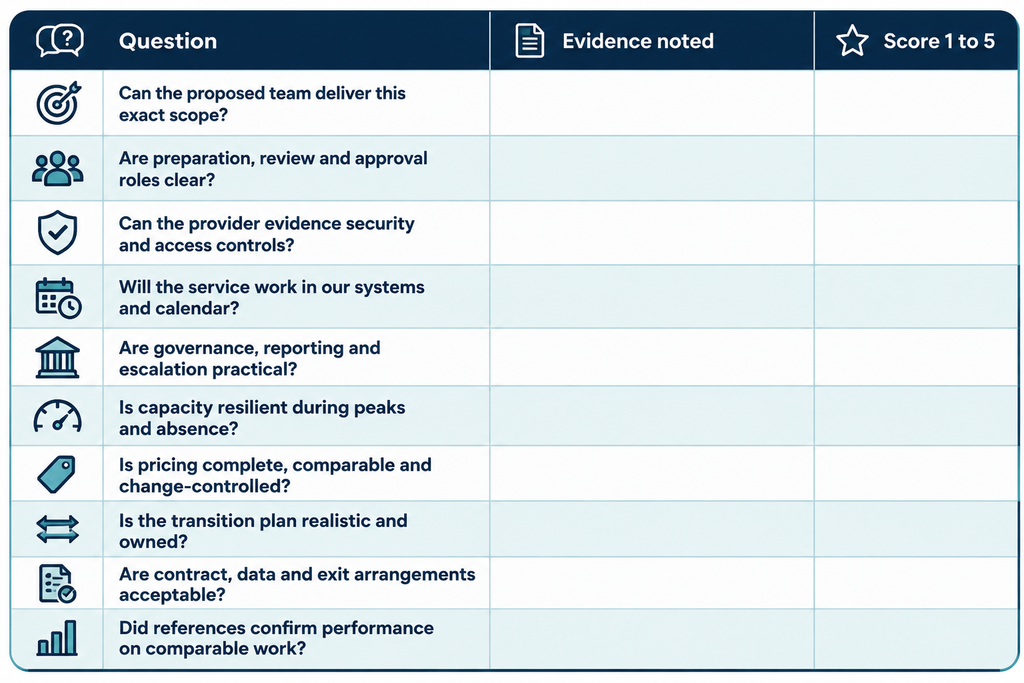
Use a scorecard to compare finance outsourcing providers
Score providers against the same weighted criteria and record the evidence behind each score. Weighting should reflect the scope: security and continuity may dominate a data-sensitive critical process, while specialist expertise may carry more weight in a complex accounting workstream. A high total should not override a failed mandatory requirement.
Watch for warning signs
- The scope describes broad support but does not identify outputs, dependencies or exclusions.
- The provider cannot name the proposed preparer, reviewer and service owner.
- One person holds critical knowledge and there is no credible cover or succession plan.
- Process documentation, completed control evidence or quality reporting is unavailable.
- System access is shared, excessive or not removed promptly when roles change.
- Locations, sub-processors or material technology dependencies are unclear.
- Pricing excludes routine exceptions or makes change charges difficult to predict.
- The transition plan relies heavily on the client but does not identify the required time.
- Exit support, data return, access closure or knowledge transfer is vague or costly.
One concern may be resolvable through clarification or a contract change. Several linked concerns often indicate that the proposed service has not been designed in enough detail.
Measure the relationship after launch
Use a small set of measures tied to the original objective. Possible measures include on-time delivery, percentage of work completed correctly first time, rework, aged open items, service-level performance, control exceptions, incident resolution, forecast versus actual volume, client review time and cost to serve. Define each measure, its data source, owner, frequency and threshold before reporting begins.
Service reviews should explain causes and actions, not simply report a red or green status. Track repeated exceptions to closure, assign an owner and due date, and confirm whether the remedy changed the process. Revisit scope, controls and capacity when systems, volumes, entities or reporting obligations change.
Choose on evidence and operating fit
The right finance outsourcing partner should strengthen delivery without obscuring responsibility. Define the problem, retained ownership and success measures; test provider claims with operational evidence; and treat transition, oversight and exit as part of the service design. That creates a decision the finance team can explain and a relationship it can manage.
Project Accountants is a specialist firm supporting the funds and finance industry. Define the scope before you compare providers. Review Project Accountants’ finance outsourcing services. then speak with the team about the processes, retained controls and delivery model your organisation needs.
Frequently asked questions
There is no reliable universal price for fund administration. Cost depends on the agreed scope, charging basis, fund and entity structure, investor numbers, transaction volume, valuation and reporting complexity, jurisdictions, interface and exceptions. Compare written proposals using the same assumptions, charging units and time horizon.
Typical scopes may include fund accounting, reconciliations, capital activity, investor records and agreed reporting. Inclusion varies by provider and mandate, so the proposal should list deliverables, assumptions, exclusions, pass-through expenses and one-off work.
Standardise data and reporting, reduce avoidable manual exceptions, set clear cut-off times, remove duplicate work and use volume forecasts to negotiate appropriate tiers. Preserve preparation, review, approval, evidence and escalation controls when redesigning the process.
Outsourced fund administration can be cost-effective when the agreed service meets the fund’s operational needs at a competitive total cost compared with internal delivery. Include implementation, client oversight, additional charges and exit costs in the comparison, alongside the provider’s expertise, controls and service capacity.