

In financial-statement audit work, audit support commonly refers to two different activities: support delivered to an audit firm as part of an audit engagement, and assistance provided to an organisation preparing for its own audit. The responsibilities, independence considerations and work performed differ significantly between these arrangements.
This article explains audit support for audit firms. Professionals join the engagement through professional secondments and can support defined areas of planning, fieldwork, documentation and completion. They work within the audit firm’s methodology, systems and review structure. The audit firm remains responsible for the engagement and the audit opinion. This article uses the UK audit framework as its principal reference point; requirements should be checked for the relevant engagement and jurisdiction.
What audit support means for audit firms
For an audit practice, audit support means assigning professionals with the appropriate competence, capabilities and time to defined engagement tasks. Depending on the assignment, they may prepare planning documentation, perform specified audit procedures, document results, coordinate information requests and respond to review points.
The support team follows the engaging firm’s audit approach, templates, systems and escalation procedures. It does not independently determine the engagement scope, make final reporting decisions or issue an audit opinion.
Where individuals supplied by another firm or service provider perform audit procedures, ISA (UK) 220, Quality Management for an Audit of Financial Statements treats them as members of the engagement team, unless a specific exclusion applies, such as for an auditor’s external expert. The audit firm must address their assignment, competence, ethical requirements, direction, supervision and review accordingly.
Assigning work to additional professionals does not remove the engagement partner’s overall responsibility for managing and achieving engagement quality.
Audit firm support and client-side preparation
Audit-firm support contributes directly to an audit engagement. Client-side preparation helps the organisation being audited maintain its records, prepare accounting schedules and respond to the auditor’s requests.
The distinction matters when defining responsibilities and assessing independence. Preparing a reconciliation for management is different from auditing that reconciliation as part of the audit engagement. The same individual or team should not be assumed to be able to prepare information for management and then audit that information.
The audit firm must determine whether a proposed arrangement is permissible and address any self-review, management or independence threats under the applicable ethical requirements. The assessment should reflect the services performed, the individuals involved, the audited entity and the relevant jurisdiction. Separate teams or safeguards do not make a prohibited service permissible.
Management and, where appropriate, those charged with governance retain responsibility for the financial statements, relevant internal controls and information provided to the auditor. These responsibilities are addressed in ISA (UK) 210, Agreeing the Terms of Audit Engagements.
What audit support can cover
The scope should reflect the engagement’s needs, the professionals’ competence and the audit firm’s available supervision and review capacity.
Planning and risk assessment documentation
Support may include preparing engagement timetables, maintaining information-request lists, documenting walkthroughs and assisting with risk assessment working papers. Proposed documentation and identified issues remain subject to the audit firm’s review and approval process.
Fieldwork and testing
Assigned professionals may perform substantive procedures or controls testing within the approved audit programme. Tasks can include inspecting supporting documents, carrying out recalculations and recording test results.
Exceptions, contradictory evidence and incomplete procedures should be documented and escalated promptly under the audit firm’s consultation and review procedures.
Audit documentation
Support may include preparing working papers, cross-referencing evidence and documenting procedures, results and conclusions. A well-organised audit file should explain the work performed and the findings reached rather than simply contain the documents collected.
ISA (UK) 230, Audit Documentation addresses what the audit record must demonstrate, including the procedures performed, evidence obtained, conclusions reached and review of the work.
Information requests and specialist coordination
Professionals may maintain prepared-by-client (PBC) request lists, follow up outstanding information and coordinate deliverables from specialists. They may also track dependencies involving tax, valuation, information technology or other subject-matter specialists.
Administrative coordination does not replace the engagement team’s evaluation of the information and specialist output received.
Completion support
Support may include preparing completion checklists, documenting assigned subsequent-events procedures, assisting with completion memoranda and responding to review points. Final conclusions and reporting decisions remain subject to the audit firm’s consultation, review and approval procedures.
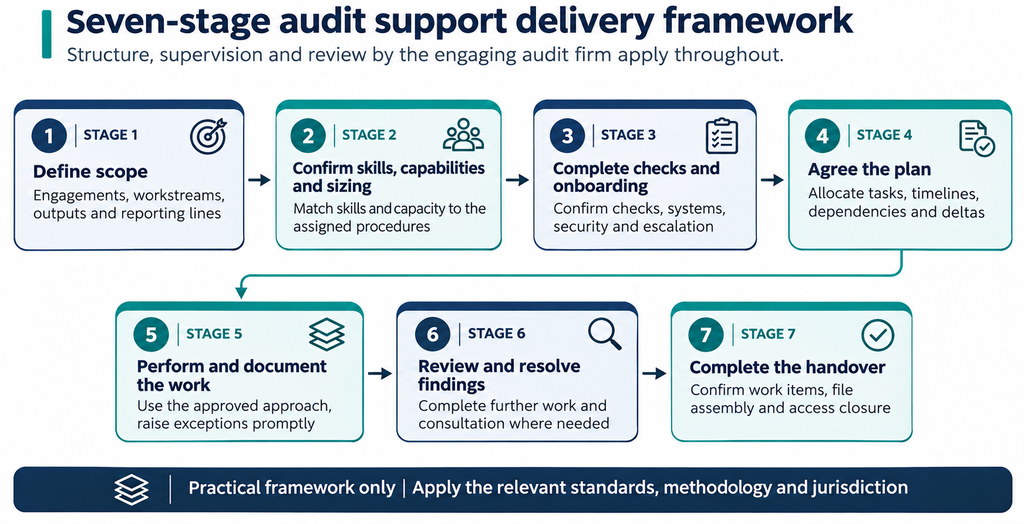
How the audit support process works
The following seven stages provide a practical delivery structure. They are not a prescribed sequence in auditing standards.
1. Define the assignment. Identify the engagements, reporting periods, workstreams, expected outputs and duration. Specify who assigns tasks, reviews the work and resolves technical questions.
2. Assess competence, capabilities and capacity. Match professionals to the applicable reporting framework, sector, systems, assigned procedures and engagement complexity. Allow sufficient time for onboarding, performance of the work, supervision and review.
3. Complete onboarding and ethical checks. Address applicable independence, conflicts, confidentiality, data protection and system-access requirements before work begins. Confirm the firm’s methodology, documentation standards, escalation routes and communication channels.
4. Agree the delivery plan. Allocate tasks and reviewers, identify dependencies and set target dates. Distinguish internal milestones from statutory, regulatory, contractual and group-reporting deadlines.
5. Perform and document the work. Complete assigned procedures using the approved audit approach. Record results and raise missing information, exceptions or matters requiring further judgement promptly.
6. Review and resolve findings. Supervisors review the work, request further procedures where necessary and assess whether responses resolve the issues raised. Significant matters follow the firm’s consultation and approval procedures.
7. Complete the handover. Confirm the status of deliverables, unresolved matters and review points. Follow the firm’s requirements for final file assembly, retention and termination of system access.
What makes audit support effective
Additional capacity is useful when it addresses the engagement’s actual needs. Effective support starts with identifying the delivery constraint. This may be fieldwork capacity, specialist competence, delayed information, inconsistent documentation or insufficient review time. The assignment should address that constraint rather than simply add more preparers to the engagement.
Before appointing a provider, an audit firm should assess:
Relevant competence: whether the proposed professionals understand the sector, reporting framework and assigned procedures.
Review capacity: whether managers and partners have sufficient time to direct, supervise and review the additional work.
Methodology fit: whether the professionals can use the firm’s systems, templates and documentation standards.
Information security: how access, confidentiality, data handling and offboarding will be controlled.
Continuity: how the parties will manage handovers, absences and changes in personnel.
Escalation: how professionals will raise contradictory evidence, incomplete procedures and unresolved findings.
Deadline pressure must not prevent professionals from reporting matters that require further investigation, judgement or consultation.
When additional audit support can help
Additional professionals may be useful during busy season, staff absences, overlapping engagements or an unexpected increase in work. A defined assignment can also help complete outstanding documentation for work already performed, resolve review points or support remaining completion procedures.
Additional resource cannot substitute for required audit evidence or justify backdating work. Omitted procedures require prompt escalation and assessment of the implications for the auditor’s report. It may also fail to resolve a bottleneck caused by delayed client information, unresolved technical matters or insufficient manager and partner review capacity.
A professional secondment can embed additional resource within the engagement team for an agreed period. Before deployment, the parties should define the assigned procedures, reporting lines, availability, system access, supervision, review responsibilities and handover requirements.
How we supports audit firms
We provides audit professionals through professional secondments to support defined areas of planning, fieldwork, documentation, information-request coordination and completion.
The scope can be defined around the engagement timetable, required competence, delivery constraints and available review capacity. Our professionals work within the engaging firm’s methodology, systems and documentation requirements, under its direction, supervision and review.
Project Accountants does not determine or sign audit opinions. The engaging audit firm remains responsible for the audit work, decisions and opinion.
Explore our Audit Support services to understand the workstreams available.
Discuss your engagement timetable, required skills and review capacity with Project Accountants.
Frequently asked questions
Yes. Professionals with the appropriate competence and capabilities may perform specified audit procedures as part of the engagement. Where individuals supplied by a service provider perform audit procedures, they form part of the engagement team under ISA (UK) 220 unless a specific exclusion applies, such as for an auditor’s external expert. Their work remains subject to the audit firm’s methodology, ethical requirements, direction, supervision and review.
No. Using professionals from another firm or service provider does not transfer responsibility for the audit. The audit firm remains responsible for the engagement and its report, while the engagement partner retains overall responsibility for managing and achieving engagement quality.
No. Client-side preparation focuses on the organisation’s accounting records, schedules, evidence and responses to the auditor. Support delivered to an audit firm contributes to the audit engagement within the firm’s methodology and review structure. The scope and responsibilities should make this distinction clear.
No. The applicable auditing, ethical and independence requirements depend on the engagement and jurisdiction. UK financial statement audits are performed under ISAs (UK), while engagements elsewhere may use international ISAs or national standards. The audit firm should confirm the applicable requirements and effective dates for the relevant reporting period.