

Private equity real estate funds pool investor commitments to acquire, finance, manage and ultimately sell property investments. Their results depend not only on asset performance, but also on how legal terms, capital calls, financing, valuations, fees, allocations and distributions are translated into controlled fund operations.
For a private equity real estate fund manager, a transaction affects property entities, debt, investor commitments, cash forecasts, fees, NAV and reporting. An error at one level can flow through the structure.
This article is written for fund managers and their finance and operations leaders, with a practical overview for administrators and family offices. It does not assess investment suitability.
Key Takeaways
- Private equity real estate funds use pooled private capital to acquire, operate, improve and exit property investments.
- The general partner or manager directs the strategy; limited partners commit capital under the governing documents and usually have limited day-to-day control.
- Core, core-plus, value-add and opportunistic strategies involve different levels of leasing, development, financing and execution complexity.
- Capital calls, property and fund valuations, fees, allocations and distribution waterfalls create connected accounting and administration requirements.
- Returns are uncertain and investor capital is usually illiquid. Leverage, refinancing, vacancy, development and exit conditions can materially affect outcomes.
- Reliable records, defined responsibilities, reviewed calculations and clear investor reporting support transparent fund operations.
What Is a Private Equity Real Estate Fund?
A private equity real estate (PERE) fund is a privately offered pooled vehicle that invests in property-related assets. Depending on its mandate, it may hold offices, logistics facilities, homes, hotels, retail property, healthcare assets, land or development projects. It may acquire assets directly or through special purpose vehicles (SPVs), often using debt alongside investor equity.
The manager pursues the investment strategy set out in the fund documents. Closed-ended funds normally have a defined term, while some private real estate vehicles operate on an open-ended basis. The commitment-based lifecycle described below focuses on closed-ended funds. Potential returns come from rental income and changes in investment value, influenced by occupancy, refurbishment, development, financing costs and eventual sale prices. Returns are not assured.
Unlike direct property owners, investors hold a fund interest and rely on its governance and allocation terms. Unlike listed real estate investment trusts, private fund interests generally have restricted transfer or withdrawal rights. The US Securities and Exchange Commission’s Investor.gov overview notes that private equity interests are often illiquid and that offering documents govern fees and expenses. Eligibility and disclosure rules vary by jurisdiction.
How a Private Real Estate Fund Is Structured
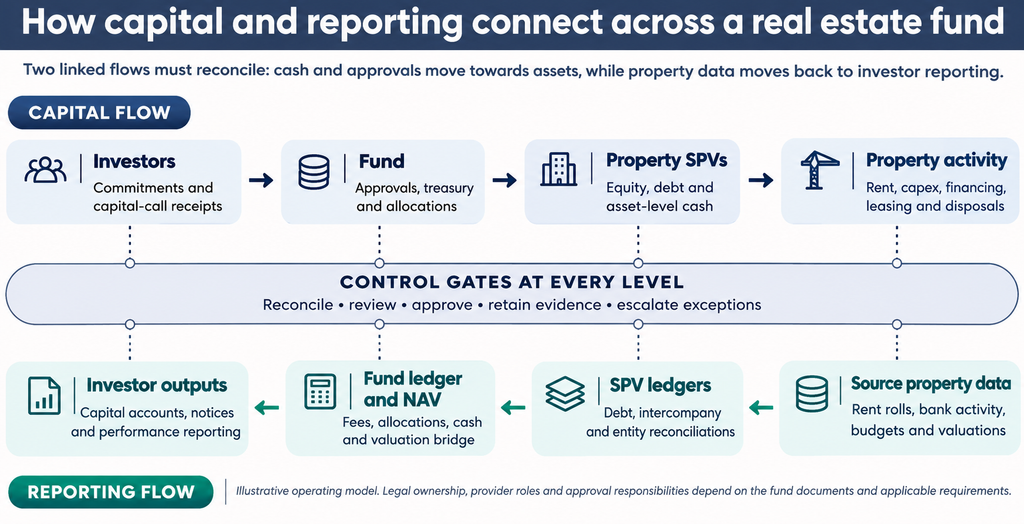
The legal form and provider model vary, but the operating relationships often include:
- General partner, governing body or authorised manager: owns the decisions and approvals allocated by law and the documents.
- Limited partners or other investors: contribute or commit capital, receive reports and exercise rights under applicable law and the governing documents.
- Fund vehicle: records investor interests and holds investments directly or indirectly.
- SPVs and property entities: hold particular assets or groups of assets and organise their financing and cash flows. The extent of liability separation depends on applicable law, guarantees, security arrangements and other contractual terms.
- Investment or asset manager: executes transactions and oversees property business plans under its mandate.
- Fund administrator: may maintain investor and accounting records, prepare calls and distributions, calculate NAV and support reporting, subject to the agreed scope.
- Property manager: handles activities such as rent collection, service charges, maintenance and tenant administration, with data feeding fund reporting.
- Other providers: depositaries, custodians, auditors, valuers, lenders and advisers perform roles required by the structure, jurisdiction or financing.
A responsibility matrix should identify preparation, review, approval, data ownership, escalation and incident response. For regulated entities, the IOSCO Principles on Outsourcing explain that outsourcing does not ordinarily transfer regulatory responsibility to the provider. The applicable obligations depend on local requirements, and each provider remains responsible for its own contractual and legal duties.
How the Fund Lifecycle Works
For a typical closed-ended fund, the lifecycle connects fundraising to the final investor statement:
- Fundraising and closing: record accepted investors, classes, commitments, side-letter terms and notice details.
- Capital calls and acquisition: approve calls, review allocations, release notices, reconcile receipts and fund acquisitions through equity, debt or both.
- Asset management: feed income, costs, capital expenditure, financing and business-plan progress into SPV and fund accounting.
- Valuation and reporting: use approved values, debt, cash and other balances in NAV, capital accounts and reports.
- Realisations and distributions: review and approve allocations and any waterfall before paying distributable proceeds.
- Wind-down: remaining assets and liabilities are resolved, final allocations are completed, records are retained and unused commitments are released under the documents.
A simplified £100 million example
Assume a hypothetical closed-ended fund receives £100 million of commitments. All contributions count towards those commitments. There are no recallable distributions or recycling provisions, and the figures are presented after recognising applicable fund expenses and any accrued carried interest.
- First call: £40 million is called and paid for acquisitions, transaction costs and initial fees. Cumulative contributions are £40 million and unfunded commitments are £60 million.
- Second call: a further £20 million is called and paid for improvements, another acquisition and working capital. Cumulative contributions rise to £60 million and unfunded commitments fall to £40 million.
- Periodic valuation: recorded assets total £74 million and liabilities total £6 million, giving an illustrative NAV of £68 million. With no distributions made so far, NAV exceeds contributions by £8 million. The accounting records must explain how much comes from income, realised gains or losses, unrealised valuation movements and expenses.
- Interim distribution: £25 million is paid to investors. If there are no other changes at that point, cash and NAV each decrease by £25 million, leaving NAV of £43 million. Cumulative contributions remain £60 million and unfunded commitments remain £40 million.
- Final exit: assume subsequent net income and valuation or disposal movements add £2 million after remaining costs. Once all assets are realised and liabilities settled, £45 million is distributed. Total distributions are £70 million, NAV is nil and the unused £40 million commitment is released under the fund documents.
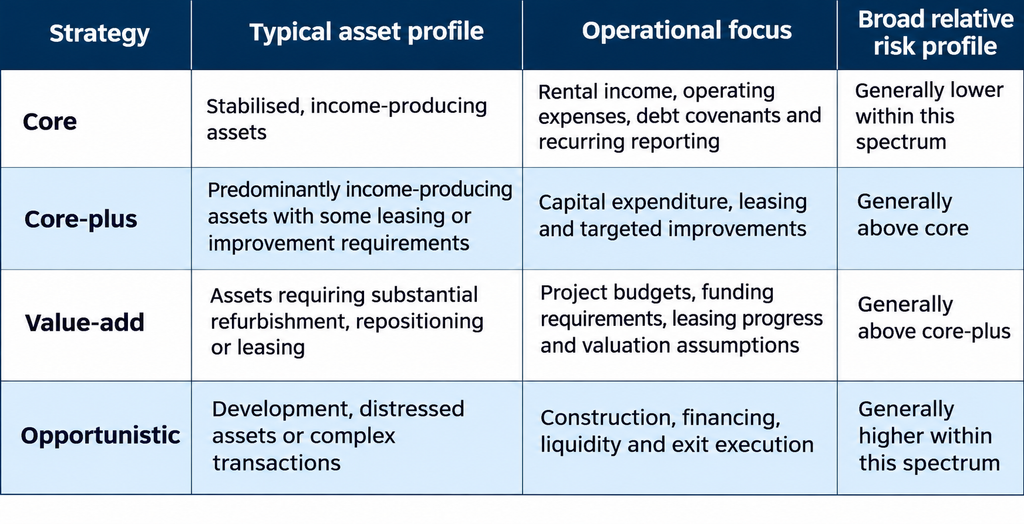
Strategy affects the operating model. A stabilised portfolio may emphasise rent, service-charge and covenant reporting. Development or repositioning adds construction budgets, commitments, drawdowns, cost-to-complete estimates and more judgement in forecasting and valuation. The actual risk depends on the assets, market, financing and execution, not the label alone.
Capital Calls and Unfunded Commitments
A commitment is the amount an investor agrees to provide under the fund documents. Contributed capital is the amount actually paid into the fund. Unfunded commitments represent the remaining funding obligation, calculated under the documents and adjusted for permitted releases, recallable distributions and recycling. Reporting should distinguish uncalled capital from amounts already called but still unpaid.
For each call, the authorised owner approves the need, amount and timetable. A preparer uses controlled investor data; a reviewer checks allocations, fee treatment, deadlines and bank instructions; and an authorised signatory releases the notice. The fund retains the source calculation, approvals, notices, delivery evidence, receipts and reconciliation.
Late, short or disputed payments enter an exception process. Default consequences must come from the governing documents and appropriate legal advice. Cash forecasts should connect investor funding dates to acquisition completions, capital expenditure, debt service and fund expenses.
Fees, Carried Interest and Distribution Waterfalls
Real estate fund economics are defined by the governing documents. Common components can include:
- A management fee calculated on commitments, invested capital, NAV or another stated base, sometimes changing after the investment period.
- Fund and transaction expenses allocated under an agreed policy.
- A preferred return or hurdle before carried interest is paid.
- A catch-up provision affecting how subsequent proceeds are divided.
- Carried interest allocated to the sponsor or performance participant.
- A clawback or other true-up intended to correct excess carry under the agreed terms.
A distribution waterfall applies the contractual sequence to proceeds. Whole-fund and transaction-based models can differ, while side letters or parallel vehicles add complexity. Version-control and review the calculation, tie it to capital records and separate payment approval from preparation where proportionate.
No fee base or waterfall step should be assumed from a market label. Investor reporting should identify the period, basis and whether performance is shown before or after fees and carried interest.
How Performance Is Measured
No single metric provides a complete picture:
- Internal rate of return (IRR) is the discount rate at which the net present value of dated contributions, distributions and any closing residual value equals zero. It is sensitive to cash-flow timing and the valuation of investments still held.
- Equity multiple compares distributions plus residual equity value with contributed equity on a stated basis. At fund level, total value to paid-in capital (TVPI) uses cumulative distributions plus residual NAV divided by cumulative paid-in capital. These measures do not capture how long the result took to achieve.
- Cash-on-cash return is commonly used at asset or deal level and compares annual pre-tax operating cash flow after debt service with a stated cash-equity investment base. Reports should define the numerator, denominator and treatment of capital expenditure, fees and distributions.
- Realised and unrealised gains or losses distinguish results recognised on disposals from valuation movements on investments still held. Rental income is a separate component of performance. Distributions may include income, sale proceeds, returned capital or financing proceeds, so a cash payment is not automatically a profit.
- Gross and net performance depend on the stated methodology. Reports should identify the fees, expenses, taxes and carried interest deducted or excluded, including whether accrued carry is recognised.
Reports should state the measurement level, valuation date, currency, period and calculation basis. Where subscription facilities affect contribution timing, explain their treatment because they can affect reported IRR. Reconcile performance outputs to the relevant cash-flow records and NAV.
Accounting, Valuation and Investor Reporting
The applicable accounting framework and entity-specific facts determine whether a fund controls underlying entities and must consolidate them. Under IFRS Accounting Standards, IFRS 10 bases consolidation on control and requires a qualifying investment entity to measure particular subsidiaries at fair value through profit or loss under IFRS 9 rather than consolidate them; specified investment-related service subsidiaries may still require consolidation.
Where another IFRS Standard requires or permits fair value measurement, IFRS 13 provides the measurement framework, subject to its scope exceptions. Fair value reflects the price received to sell an asset or paid to transfer a liability in an orderly transaction between market participants at the measurement date.
IAS 40 addresses qualifying investment property, generally property held to earn rentals, for capital appreciation or both. It generally permits a fair value or cost model for subsequent measurement, subject to its requirements. Other property uses can require different treatment: for example, property developed for sale in the ordinary course of business generally falls under IAS 2 Inventories. Fund-level accounting for an interest in a property entity must be distinguished from that entity’s accounting for its property.
Property valuation may use comparable transactions, capitalised income or discounted cash flow. Relevant assumptions include rents, occupancy, operating costs, capital expenditure, yields, discount rates and development progress. The valuation policy should define methods, frequency, responsibilities, review and approval.
The 2025 IPEV Valuation Guidelines provide best-practice recommendations for private-capital fair value measurement, including real estate investments. Published in December 2025, they supersede the 2022 edition and are considered in effect for quarterly reporting periods beginning on or after 1 April 2026. Applicable accounting standards, laws and regulations take precedence.
NAV calculations should use a consistent measurement date and a clearly stated accounting or reporting basis. Where a property-entity interest is valued on an equity basis, debt already reflected in that valuation must not be deducted again at fund level. Reconcile investment values and other assets, cash, borrowings, accruals and liabilities to the fund records. Distinguish financial-statement NAV from any adjusted reporting measure, such as INREV NAV.
Investor allocations should follow the applicable class, equalisation, fee and carried-interest terms. The INREV Guidelines provide an industry reference for non-listed real estate governance, reporting, property valuation, performance measurement, NAV and fee metrics. Their use depends on the vehicle documentation and the agreed module-by-module level of adoption and compliance; they are not automatically mandatory for every fund.
Project Accountants can provide fund accounting and Fund Administration Support around NAV preparation, financial reporting, reconciliations and audit readiness. Responsibility for valuation conclusions, accounting policies and approvals remains with the appropriately authorised client parties and advisers.
Principal Risks to Monitor
- Illiquidity and exit risk: a sale or investor transfer may take longer or achieve a different price than expected.
- Leverage and refinancing risk: rates, covenants, maturity dates and lender appetite can affect cash needs and asset strategy.
- Vacancy and operating risk: tenant failure, voids, repairs and operating costs can reduce income.
- Development risk: planning, procurement, construction, cost inflation and completion timing can change funding requirements.
- Valuation risk: non-observable inputs and changing markets can create material uncertainty.
- Concentration risk: exposure to one property, tenant, geography or sector can amplify an adverse event.
- Manager, regulatory and operational risk: conflicts, weak controls, reporting failures, cyber incidents or provider disruption can affect the fund independently of property performance.
Risk reporting should connect thresholds to owners and actions. Covenant breaches, missing valuation data and cash shortfalls need escalation, documented decisions and follow-up. Legal, tax and regulatory conclusions require qualified specialists.
Operational Checklist for Fund Managers
- Map the structure and terms. Maintain an entity chart and controlled summary of commitments, fees, waterfalls, side letters, borrowing limits and approval rights.
- Assign ownership. Define who prepares, reviews, approves and releases calls, payments, valuations, NAV, reports and investor communications.
- Reconcile connected records. Tie property systems, SPV ledgers, debt, bank accounts, the fund ledger, investor register and capital accounts.
- Control property data. Set cut-offs, validation checks and escalation for rent, vacancies, capital expenditure, forecasts and valuation inputs.
- Forecast cash and commitments. Combine acquisitions, capex, operating cash, debt, fees, calls, distributions and unfunded commitments.
- Govern valuations and NAV. Retain inputs, challenge, approvals and a bridge from the prior period, with exceptions separately tracked.
- Test fees and waterfalls. Reperform calculations, confirm the contractual base and preserve approved versions and payment evidence.
- Monitor providers and resilience. Review service levels, access rights, incident escalation and continuity plans; retain enough records to continue critical processing.
- Make reporting traceable. Reconcile statements and performance metrics to approved books, cash and valuation dates before release.
Building Reliable Real Estate Fund Operations
Reliable fund operations depend on the connection between property records, entity accounts and investor reporting. Finance teams need to explain how transactions, income, debt, expenses and valuation movements affect cash, NAV and investor balances.
We supports private real estate fund managers and fund administrators through Fund Accounting, Fund Administration Support and Operational Finance Outsourcing. Depending on the agreed scope, our teams assist with fund and SPV accounting, capital-call and distribution calculations, reconciliations, reporting preparation and audit support.
We work within clients’ or appointed providers’ systems and control frameworks. Project Accountants is not a regulated fund administrator, AIFM or depositary; the authorised parties retain oversight, approvals
Frequently Asked Questions
Potential returns come from rental income and gains on property or other investments, after relevant costs. Refurbishment, leasing and development may improve income or sale value. Refinancing can release cash or change financing costs, but additional borrowing does not itself create profit. Results depend on expenses, leverage, fees, timing and market conditions.
In a limited partnership, the GP has the management role established by applicable law and the partnership agreement. Investment management may be delegated to a separate manager. LPs provide capital and have information, voting or consent rights under applicable law and the documents, usually without participating in daily management.
It is a formal request to contribute part of a commitment by a deadline for a purpose permitted by the fund terms.
There is no universal term. For a closed-ended fund, the documents specify the investment period, fund term and extension provisions. Asset sales and wind-down affect when investors receive their final payments. Open-ended private real estate vehicles may operate without a fixed termination date, with subscriptions and redemptions subject to their terms.
The accounting framework, documents and valuation policy determine the basis. Property values, debt, cash and other balances feed fund-level NAV.
Terms may include management, transaction, property or performance fees and allocated expenses. The agreements define amount, base, timing and recipient.
An administrator may maintain records, prepare calls, distributions and NAV, process cash and support reporting. Authorised bodies retain decisions and oversight.
They are different concepts. REIT status depends on a jurisdiction’s legal and tax requirements, while a private equity real estate fund describes an investment vehicle and strategy. REITs can be listed, public non-listed or private, and a private fund may hold investments through a REIT. Liquidity, taxation and capital arrangements depend on the particular structure.