

Active asset management uses research and portfolio decisions to pursue a stated objective, such as outperforming a benchmark, generating income or managing a defined risk. Passive asset management seeks to track a specified benchmark or index through a disclosed method, before costs. The central difference is whether the strategy seeks to track a benchmark or pursue its objective through active portfolio decisions, including systematic rules.
These are management approaches, not product labels. Pooled funds, including ETFs, can use either strategy; segregated mandates can also be designed in different ways. For a family office, trustee or finance team, the assessment extends beyond headline fees or recent returns. It should consider the objective, benchmark, risk, liquidity, implementation, governance and reporting needed to oversee the portfolio.
Key Takeaways
- Active strategies make portfolio decisions within a mandate, including through systematic rules; passive strategies seek benchmark-linked exposure through an agreed tracking method.
- Neither label determines the right vehicle, total cost, risk or eventual return. The benchmark and the investor’s objective both matter.
- Finance teams need reliable records of positions, fees, benchmarks and cash flows to support oversight and reporting.
What Active Asset Management Means
An active manager makes portfolio decisions within an agreed mandate. The process may include economic and company research, security selection, asset allocation, position sizing, currency management and decisions about when to buy or sell. Some strategies make frequent changes; others hold concentrated positions for long periods. Turnover is therefore a characteristic to examine, not a defining rule.
The objective should be explicit. A strategy may seek to exceed a specified benchmark, deliver an absolute return, produce income or manage downside, volatility or another risk. Those aims are not guaranteed outcomes. Results depend on the mandate, the manager’s process, the market environment, costs and the period used for assessment. A relevant comparison should examine performance after fees, alongside the amount and type of risk taken.
Oversight should identify where performance came from. Analysis may separate broad market movement from selection, allocation, currency and cash effects where the data and methodology support it. Tracking error can describe the variability of returns relative to a benchmark, but it does not show whether active decisions added value. Read it with the mandate, exposures, costs and investment process.
What Passive Asset Management Means
A passive strategy seeks to track a specified benchmark or index. A rules-based strategy is not automatically passive: systematic active strategies can also follow rules while seeking a different objective. Implementation may involve full replication, where the portfolio holds all index constituents in approximately their index weights, or sampling, where it holds a representative selection. Other disclosed techniques may be used when direct replication is impractical. The chosen method affects trading, liquidity, operational complexity and the closeness of the result to the benchmark.
Passive management is not decision-free. The governing body or appointed investment decision-maker still needs to select an appropriate exposure, benchmark, vehicle and implementation method. A portfolio can also be actively allocated while its underlying funds track indices. Index providers make methodology choices about eligibility, weighting and rebalancing. Those rules can create concentration by issuer, sector or geography, as well as liquidity and methodology risks. A passive portfolio also remains exposed to the market risks present in the securities it tracks.
The portfolio is unlikely to match its benchmark exactly. Tracking difference is the return gap between the portfolio and benchmark over a stated period. Tracking error describes how variable that gap is over time. Fees, transaction costs, taxes where relevant, cash balances, sampling, trading around index changes and the timing of rebalancing can all affect the result. The monitoring question is therefore how closely and efficiently the strategy delivered its stated benchmark-linked exposure, after costs and within its operating constraints.
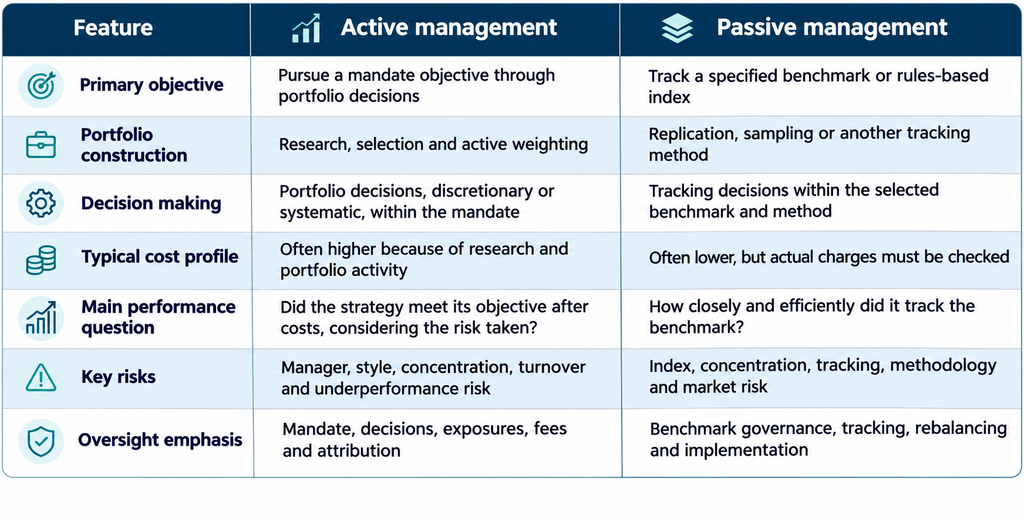
Active vs Passive Asset Management at a Glance
The comparison is most useful when it starts with the mandate rather than an assumption that one approach is inherently superior. Active management places more emphasis on manager decisions and how those decisions contribute to the objective. Passive management places more emphasis on benchmark design, implementation and tracking. Both require cost, risk and governance oversight.
Benefits and Limitations of Each Approach
Active management can depart from a benchmark and respond to information within the mandate. It may target specific exposures, exclusions, income patterns or risk outcomes, and research or stewardship activity may inform portfolio decisions. That flexibility introduces questions about whether the process is repeatable, how much the outcome depends on individuals or a particular investment style, and whether value was added after fees, trading costs and risk. Concentration, turnover and style drift also need to be understood rather than inferred from an active label.
Passive management can provide transparent, benchmark-linked exposure through a consistent implementation process. Charges and turnover are often lower than for comparable active strategies, although neither outcome is universal. The actual product, market and trading arrangements matter. A low headline management fee may sit alongside transaction costs, spreads, custody charges or operational burdens that affect the total cost of ownership.
The main limitation of a passive approach is that the benchmark largely determines what the portfolio owns and how positions are weighted. If the benchmark is poorly aligned with the investment objective, efficient tracking will not resolve that mismatch. Market-cap-weighted indices may become concentrated in larger constituents, while narrower indices may embed sector, geography or liquidity exposures. Index changes can also prompt trading at predictable times.
Neither approach removes the need for judgement. Active oversight focuses on the manager’s mandate, process, decisions and outcomes. Passive oversight focuses on benchmark suitability, index methodology, tracking and implementation. In both cases, performance should be interpreted over an appropriate period and alongside risk, costs, liquidity and the role the allocation is intended to play.
Factors to Assess When Choosing an Approach
The starting point is the investment objective and the constraints around it. A family office or governing body may need to consider liabilities, time horizon, liquidity needs, cash-flow expectations and the amount of risk that can be accepted. These factors help define what the allocation is meant to do; they do not by themselves prescribe active or passive management.
Benchmark suitability is equally important. The benchmark should represent the exposure or opportunity set against which the strategy is intended to be assessed. A widely recognised index may still be unsuitable if its constituents, weighting rules, currency treatment or rebalancing method do not match the mandate. Where no credible benchmark exists, the review framework may need additional objectives and risk measures rather than a forced comparison.
The assessment should then consider the market or asset class, the required level of customisation, any exclusions or stewardship expectations, and the practical availability of suitable managers or products. Costs should be examined in total, including management and performance fees where applicable, trading, spreads, custody, administration and implementation effects. Tax consequences are structure- and jurisdiction-specific and require appropriate advice.
Finally, the oversight model must be realistic. Active arrangements may require greater capacity to assess people, process, positions and performance attribution. Passive arrangements require reliable benchmark records, tracking analysis and governance around index changes. Both depend on timely data, consistent valuation and a process for replacing a manager or product where authorised decision-makers determine that action is appropriate.
Governance capacity is part of the cost of the arrangement. Review papers should state the decision being considered, the evidence relied upon, any conflicts identified and the action owner. The review frequency should reflect the mandate and risk rather than create activity without purpose. Where trustees, family members, an investment committee and external advisers have different responsibilities, a documented authority matrix helps prevent decisions or exceptions from falling between roles.
Can Active and Passive Strategies Be Combined?
A portfolio can use active and passive management across different asset classes, regions or mandates. One example is a core-satellite structure, in which a benchmark-linked allocation sits alongside smaller active allocations. This is a description of an arrangement, not a recommendation: the appropriate structure depends on the investor’s objectives, constraints and authorised advice.
A blended portfolio needs clear role definitions. The governing body should understand why each sleeve exists, which benchmark applies and whether active and passive holdings create unintended overlap. Total cost should be consolidated rather than reviewed manager by manager. Liquidity and rebalancing rules also need to work across the portfolio, particularly where one component can be traded more readily than another.
Reporting should preserve the distinction between the strategies while showing the combined result. This requires consistent performance periods, currencies, benchmark conventions and treatment of fees and cash flows. Without those controls, a blended approach can look diversified while duplicating exposures or presenting comparisons that are not like for like.
Operational Oversight and Reporting
The management approach changes what needs to be monitored, but both depend on controlled investment data. The family office or finance team should maintain approved mandates, benchmark definitions and effective dates. Changes to an index methodology, manager mandate or fee schedule should be recorded with the relevant approval so that performance reports use the right basis for each period.
Positions, transactions, cash, income and fees should be reconciled across managers, custodians and the accounting records. Breaks need a named owner, an ageing status and a clear route for escalation. Fee calculations should be checked against governing documents or agreed terms, with unusual movements investigated. For active strategies, the team may also monitor exposures, concentration and mandate restrictions. For passive strategies, the focus may include tracking difference, tracking error, rebalancing and activity around index changes.
Performance reporting should separate effects where the data permit. Market movement, manager decisions, currency, fees and external cash flows answer different questions and should not be merged into one unexplained return. Consolidation adds another control challenge: portfolios may use different valuation dates, currencies, fee bases and benchmark conventions. The reporting process should avoid double counting and should not combine incompatible periods without clear adjustment or explanation.
Reliable records support manager reviews, governance meetings, audit preparation and follow-up. Evidence should show which data were used, who reviewed the report, which exceptions remained open and how decisions were approved. Project Accountants describes operational finance outsourcing for accounting records, reconciliations and management reporting. Its fund accounting service also covers financial reporting and audit readiness where relevant to the structure. This operational support does not include selecting investments, managing assets or recommending a strategy.
Data definitions should be agreed before reports are automated. Gross and net returns, benchmark versions, foreign-exchange rates, accrued income and fee treatment need consistent rules. A change log should capture restatements and revised source files, while access controls and review sign-offs help protect the integrity of the reporting pack. These controls make it easier to explain differences between a manager report, custodian statement and the family office ledger without silently overwriting the audit trail.
Questions for Manager or Product Review
A review should test whether the stated strategy, operating arrangements and information supplied are consistent. The following questions give finance and governance teams a practical starting point:
- What objective and benchmark apply, and why are they appropriate for the mandate?
- Which decisions are discretionary, systematic or driven by benchmark rules?
- What management fees, performance fees, trading costs and other charges apply, and how are they reported?
- How will performance be measured after costs and with suitable risk and time-period context?
- For an active strategy, how are style drift, concentration, mandate limits and decision accountability monitored?
- For a passive strategy, how are tracking difference, tracking error, sampling and index changes handled?
- What position, transaction, cash-flow, fee and performance data will the finance team receive, in what format and how often?
- How are mandate breaches, valuation issues, failed trades, stale data and reconciliation differences escalated?
Document the answers in the reporting calendar, responsibility map and review papers. Record material changes, challenge unsupported explanations and track agreed actions to completion.
Improve Oversight Across Investment Data and Financial Reporting
Active and passive portfolios can create different data, benchmark and reporting demands. Project Accountants supports accounting, reconciliations and financial reporting through its operational finance and fund accounting services where relevant. Discuss the records, reporting scope and delivery model with the team.
Active management uses portfolio decisions, including systematic rules, to pursue a stated objective within a mandate. Passive management aims to track a specified benchmark or index, before costs. Portfolio construction, turnover, fees and performance assessment vary by strategy.
Not exactly. Passive management describes a strategy, while an index fund is a fund designed to track an index. An index fund may be exchange-traded or take another pooled-fund form, depending on its structure and jurisdiction. The vehicle determines how interests are issued, traded and priced. Implementation may use full replication or a sample of index holdings. Check the relevant product documents.
No. Both exchange-traded funds and mutual funds can use active or passive strategies. The vehicle affects features such as how shares are bought, sold and priced, while the investment strategy determines whether the portfolio seeks to track an index or pursues an active objective.
Active management often has higher charges, although this is not universal and depends on the specific strategy and product. Compare the actual management and performance fees, trading costs, spreads, custody and administration costs for the specific product or mandate. A headline fee does not show the full cost of ownership.
Neither is universally better. The appropriate assessment depends on the objective, market, benchmark, risk, liquidity, cost, implementation and capacity for oversight. The decision should be made by authorised parties using the investor’s circumstances and appropriate professional advice.
Tracking error usually measures the variability, often the standard deviation, of periodic return differences between a portfolio and its benchmark. Tracking difference is the return gap over a stated holding period. Specify the calculation frequency, period, currency and treatment of fees before comparing figures.
Yes. Different approaches may be assigned to separate asset classes or portfolio roles. Oversight should identify the purpose and benchmark for each allocation, test for duplicated exposures, consolidate total costs and apply consistent treatment of currencies, periods, fees, liquidity and rebalancing.