
Private market liquidity is the ability to convert a private asset or fund interest into cash, and to meet related cash obligations, without unacceptable delay, cost or value loss. It is shaped by the underlying assets, the fund’s terms and cash position, and the routes available to an investor who wants to exit.
For a fund operations team, liquidity becomes tangible when a call is issued, a distribution allocated, a redemption processed or an expected exit moves. Each event depends on complete records, cash forecasts and decisions made under the governing documents.
This guide is written primarily for fund managers and their finance and operations leaders. It is also relevant to fund administrators and family offices that monitor private fund commitments. It explains the mechanics rather than assessing whether any investment is suitable.
Key Takeaways
- Private assets usually take longer to sell than publicly traded securities, but asset illiquidity is only one part of the picture.
- A lock-up restricts access for a stated period; it is not necessarily the same as the fund’s total life or the time an investor will wait for its final cash return.
- A commitment is not the same as cash contributed. Unfunded commitments remain a future liquidity obligation until called, cancelled or otherwise dealt with under the fund terms.
- Secondary transfers may provide an exit, but consent, diligence, documentation, pricing and settlement can all constrain the route.
- Semi-liquid funds provide limited liquidity through periodic redemptions or repurchase offers, depending on the structure. Capacity limits, notice periods, gates, deferrals or suspensions may restrict when and how much an investor can withdraw.
- Good operations depend on clear ownership, reconciled investor records, controlled calculations, documented approvals and timely reporting.
What Is Private Market Liquidity?
Liquidity describes how readily an asset can be converted into cash. Unlike a listed share with an established trading venue, a private company stake, loan, property or infrastructure asset may require a buyer, diligence, negotiated terms and a lengthy settlement. There may be no continuous market price.
For private funds, it helps to separate three connected layers:
- Asset liquidity: how readily the underlying investment can be sold, refinanced or repaid.
- Fund-level liquidity: whether the fund has enough cash and expected inflows to meet expenses, investment obligations, financing needs and any permitted redemptions.
- Investor-level liquidity: when and how an investor can receive cash, whether through distributions, redemptions, a transfer or final liquidation.
These layers do not always move together. A fund may retain portfolio income for follow-on investment, while a semi-liquid vehicle may receive redemption requests before assets can be sold on acceptable terms. The governing documents define what may be called, retained, distributed, redeemed, deferred or restricted.
Private market liquidity should therefore be read as a set of contractual rights, operational processes and cash-flow dependencies, not as one date on a product summary.
How the Private Fund Lifecycle Affects Liquidity
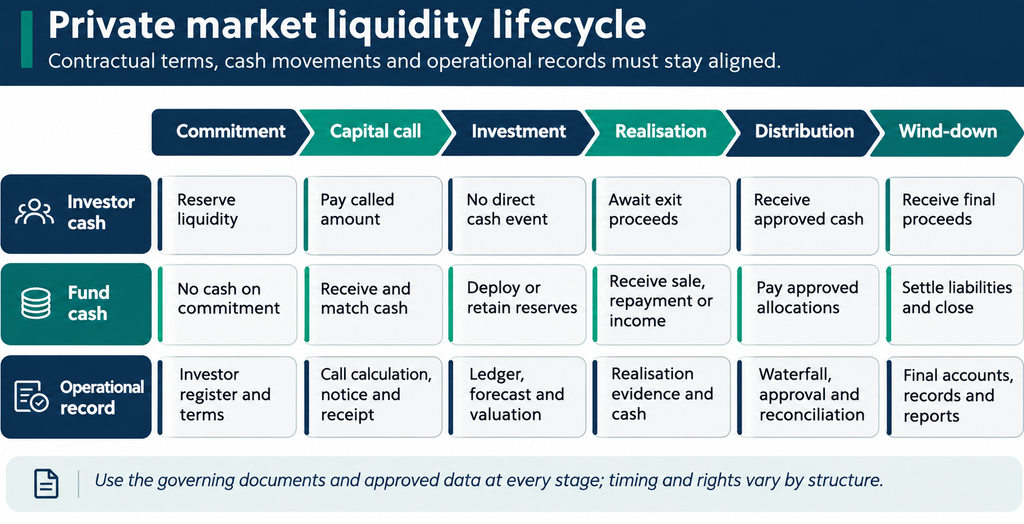
1. Fundraising and investor commitments
In a typical drawdown fund, an investor commits capital without transferring it all on day one. The manager and administrator establish the investor register, commitment, ownership and notice details, and relevant closing adjustments. Investors plan access to sufficient liquidity to meet future capital calls. The fund tracks the amounts that remain callable and the conditions governing further drawdowns.
2. Capital calls and deployment
When capital is required, the authorised party determines the call. The calculation is prepared across investors, reviewed against commitment data, approved and communicated through a controlled notice process. Receipts are matched to the call; shortages and late payments enter an exception log. Default remedies come from the fund documents and appropriate legal advice.
3. Investment and value creation
During the holding period, cash may fund acquisitions, follow-ons, expenses, debt service and reserves. Finance teams monitor cash, commitments and portfolio information. Valuations support NAV and reporting, but reported value is not immediately realisable cash.
The 2025 International Private Equity and Venture Capital Valuation Guidelines set out recommended best practice for measuring the fair value of private capital investments. They supersede the 2022 edition and are considered effective for quarterly reporting periods beginning on or after 1 April 2026. Applicable law, regulation and accounting standards take precedence; fund documents and valuation policies set out the fund’s procedures and approvals within those requirements.
4. Realisations and distributions
Cash may arise from a sale, refinancing, repayment or income. Before payment, the fund confirms cash, liabilities and reserves; calculates allocations and any waterfall; obtains approval; and reconciles payment to the ledger and investor records. Communications should distinguish forecasts from approved amounts.
5. Final exits and fund wind-down
Remaining assets may take longer than expected to realise. Extension provisions may allow time, subject to the terms and consents. Wind-down includes settling liabilities, final allocations and reports; the legal end date and last cash movement may differ.
What Is a Private Market Lock-Up Period?
A private market lock-up period restricts an investor’s ability to redeem or withdraw capital for a stated time. A hard lock-up prevents withdrawal during that period; a soft lock-up may allow it subject to a charge or other conditions. The precise restriction depends on the fund documents.
The expression varies by structure. In a closed-end drawdown fund, investors commonly have no ordinary redemption right during the fund’s life and generally receive distributions as investments generate proceeds. In an evergreen or semi-liquid structure, an initial lock-up may operate alongside periodic redemptions or repurchase offers and other liquidity controls.
A lock-up should not be confused with:
- The investment period, during which new investments may be made.
- The holding period of an individual asset.
- The fund term, including any permitted extensions.
- The notice and settlement timetable for an allowed redemption.
There is no universal private market lock-up period. The fund documents, share or unit class, jurisdiction and strategy matter. Operational planning should model the contractual base case and credible delays, including extensions, slower exits and settlement timing.
Capital Calls and Unfunded Commitments
An investor commitment is the agreed amount the investor undertakes to contribute under the fund documents. Contributed capital is the amount actually paid. The remaining unfunded commitment must be calculated under the fund terms, including any permitted recallable amounts, commitment releases or other adjustments. Called but unpaid capital should be identified separately, with reporting making clear whether it is included in the stated unfunded balance.
Consider a simplified example in which both capital calls are paid in full and count against the commitment:
- An investor makes a £10 million commitment.
- The fund calls and receives £2.5 million for an acquisition and costs, leaving £7.5 million unfunded.
- It later calls and receives £1.5 million, leaving £6 million unfunded.
- The investor then receives an £800,000 distribution.
- If the distribution is not recallable and no other adjustment applies, the unfunded commitment remains £6 million.
- If the full £800,000 restores callable capacity under the fund terms, the unfunded commitment becomes £6.8 million.
The example separates contributions, distributions and remaining funding obligations. Actual calculations may also involve commitment releases, exclusions, defaults, fees, equalisation and currency effects. The commitment amount should not be presented as an absolute cap on every possible investor liability; separate obligations may arise under the fund documents and applicable law.
Project Accountants can provide additional Fund Administration Support to regulated businesses for call calculations, investor allocations, reconciliations and reporting while working within the client’s systems and controls. The client retains the decisions, authorities and oversight appropriate to its structure.
How Investors May Obtain Liquidity
- Fund distributions: cash is returned when the fund has distributable proceeds and the relevant body approves payment. Timing and amount depend on portfolio events, liabilities, reserves and waterfall terms.
- Final liquidation: remaining cash is distributed after assets are realised and obligations provided for; this is not an early exit mechanism.
- Secondary transfer: an investor sells its interest to another party. Consent, eligibility checks, diligence, specialist documentation, register updates and reconciliations may be required. Price can differ from NAV, including at a discount, and completion is not assured.
- Periodic redemption or repurchase: depending on its legal structure, an open-ended or semi-liquid fund may offer contractual redemption opportunities or periodic offers to repurchase interests. The applicable rules and fund documents determine request deadlines, pricing, capacity, allocation where requests exceed the available amount, and payment timing. An investor may be unable to withdraw the full amount requested.
- Tender or manager-led event: a fund or third party may offer liquidity to eligible investors. Participation, price and conflicts require careful governance and specialist advice.
These routes have different legal and operational requirements. Investors should establish whether liquidity depends on a contractual redemption right, a repurchase offer or a secondary buyer, and which conditions determine the amount and timing of payment.
Closed-End vs Semi-Liquid Private Funds
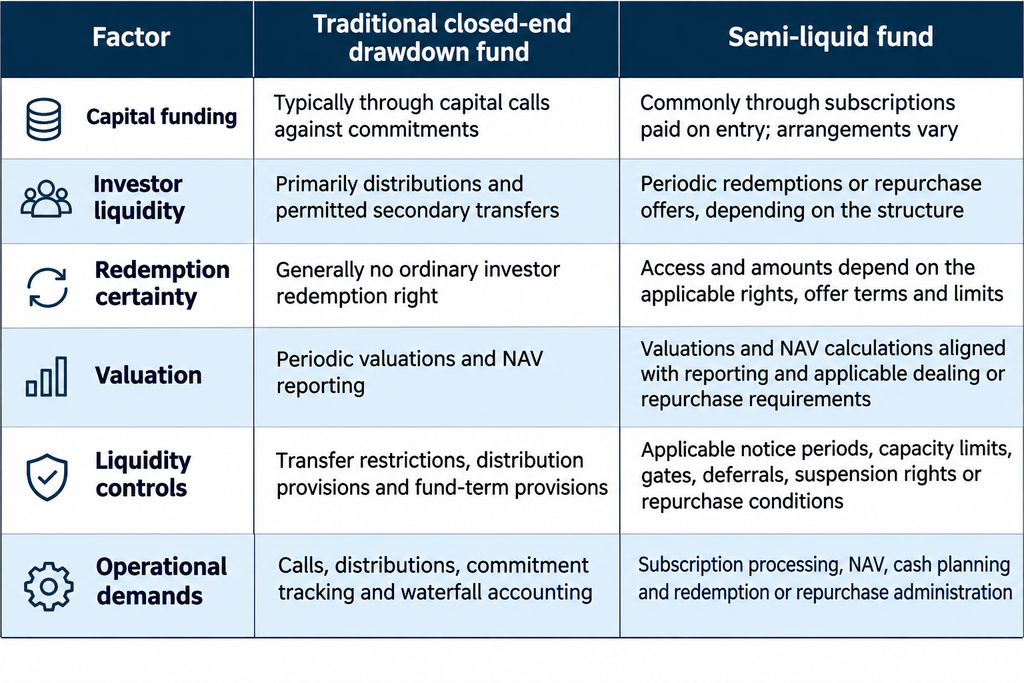
“Semi-liquid” is a market description rather than a single legal category or a guarantee of access. IOSCO’s 2025 liquidity risk management recommendations and related guidance for open-ended funds address the alignment of redemption terms with asset liquidity, the governance and use of liquidity management tools, and disclosures to investors. Their implementation depends on the relevant jurisdiction. The availability and operation of gates, deferrals and suspensions must be checked against applicable requirements and the fund documents.
Jurisdiction-specific rules can be more prescriptive. Under the UK FCA’s Long-Term Asset Fund rules, redemption determinations must not be made more frequently than the scheme’s dealing frequency and, in any event, more than once a month. The notice period must be at least 90 days after the day on which the redemption request is accepted. The prospectus also specifies the applicable payment arrangements, so 90 days should not be presented as a guaranteed request-to-cash timetable. These requirements are specific to LTAFs.
Operational Challenges for Fund Managers
Cash and liquidity forecasting
A useful forecast separates available cash, restricted cash, probable inflows, expected outflows, facilities, calls and redemptions. Assumptions need dates and owners. Actual movements are compared with forecast and material variances explained.
Proportionate stress testing can combine slower exits, delayed income, follow-on needs, facility limits and elevated redemptions. It may also be required by applicable regulation. The responsible body agrees scenarios, reviews results and decides responses.
Calls, distributions and investor allocations
Errors in commitment data or allocation rules can affect many investors. Control static data and model versions, separate preparation and review where proportionate, and reconcile notices, bank activity, the ledger and capital accounts.
If an error occurs, stop processing where necessary, quantify the impact, escalate, approve remediation and preserve the audit trail. Coordinate communications with legal or compliance review where required.
NAV and valuation governance
Private valuations often rely on non-public inputs. The policy should set methods, data, frequency, roles, challenge and treatment of subsequent information. Preparers retain support for inputs; reviewers document challenge and approval.
The latest NAV may refer to an earlier measurement date and differ from a current secondary price. Reporting should show that date and not present NAV as cash available to investors.
Redemptions, gates and transfers
Semi-liquid structures need a request register showing receipt, eligibility, amount, applicable NAV, any restriction, approval and settlement. Apply documented rules consistently and reconcile accepted requests to units cancelled and cash paid.
For transfers, track consent, buyer eligibility, checks performed by the responsible party, documents, fee treatment, register updates and opening balances. Give exceptions an owner and escalation date.
Reporting, evidence and provider oversight
Investor reporting should connect capital activity, commitments, NAV and liquidity restrictions using consistent cut-off dates, distinguishing realised cash, reported value and future obligations.
Outsourcing arrangements need clear responsibilities, continuing oversight and access to records. IOSCO’s 2021 Principles on Outsourcing address retained regulatory responsibility for entities within their scope; they should not be treated as a universal rule for every private fund structure. For each engagement, establish the applicable legal and regulatory requirements, contractual obligations, service levels, review evidence, escalation procedures, continuity arrangements and access rights.
Private Market Liquidity Checklist
- Read the controlling terms. Record the fund term, extensions, call and distribution provisions, transfer conditions, redemption rights and liquidity tools by class.
- Assign responsibility. Document who decides, prepares, reviews, approves, communicates and releases each capital or liquidity event, including cover for absences.
- Reconcile commitments. Tie the investor register, contributed capital, recallable amounts and unfunded commitments to the ledger and latest approved notices.
- Maintain a rolling cash forecast. Include asset activity, expenses, financing, calls, distributions, redemptions, reserves and timing uncertainty.
- Control standing data. Restrict and evidence changes to investor, bank, class and allocation data; independently verify sensitive payment changes.
- Govern valuations. State the measurement dates, methods, inputs, approvals and subsequent-event process, and identify the date behind each reported NAV.
- Model liquidity pressure. Test proportionate scenarios and document the assumptions, thresholds, actions, decision owners and follow-up.
- Control redemption and transfer queues. Time-stamp requests, check eligibility, apply terms consistently and track approvals, deferrals, settlement and register changes.
- Prepare communications from approved data. Reconcile amounts before issue, distinguish forecasts from approvals and retain delivery evidence.
- Test oversight and failure response. Monitor providers, maintain record access and rehearse continuity after a system or provider failure.
Managing Liquidity Across the Fund Lifecycle
Managing private market liquidity requires finance and operations teams to connect contractual terms with cash requirements, investor activity and reporting throughout the fund lifecycle.
Project Accountants supports fund managers, fund administrators and finance teams through Fund Administration Support, fund accounting, Operational Finance Outsourcing and Professional Secondments. Agreed deliverables can include capital call and distribution calculations, investor allocations, reconciliations, cash-flow reporting and reporting preparation. We take responsibility for those deliverables within the agreed scope, with preparation, review, approval and escalation responsibilities defined for each engagement.
From capital calls and distributions to financial and investor reporting, reliable fund operations depend on accuracy, efficiency and effective controls
Frequently Asked Questions
It is the ability to turn a private asset or fund interest into cash and meet cash obligations. Time, price and restrictions all matter.
There is no standard duration. It depends on the structure, class, jurisdiction and documents. Consider it alongside the fund term, extensions, notice and settlement arrangements.
Sometimes. Routes may include a permitted secondary transfer, redemption window or tender. Consent, capacity, price, eligibility, documentation and timing can constrain each route.
It is the remaining commitment available to be drawn under the fund terms, including applicable adjustments for recallable amounts and commitment releases. Called but unpaid amounts should be identified separately, and the reporting convention should be clear. Investors need to plan for the resulting funding obligations.
No. Periodic dealing may be subject to notice, gates, deferral, suspension, cash and valuation timing. The fund documents define the rights.
The applicable accounting framework determines the measurement basis. Where fair value is required, it reflects market conditions at the measurement date, using appropriate techniques, inputs and judgement. Fund documents and valuation policies set out the process and approvals within applicable requirements. A published NAV relates to a specified date and may differ from a subsequent sale price.
Depending on its mandate, an administrator may maintain records, prepare calculations, issue approved notices, process cash and support NAV, reporting and reconciliations. The authorised body retains its decisions and oversight.