

Jersey fund regulation offers several routes rather than one standard regime. The right route depends on who will invest, where the fund will be marketed, whether it is open or closed ended, the legal form and the level of regulatory oversight intended. Those choices also shape the fund’s administration, accounting, compliance, governance and reporting model.
This guide is for fund managers and sponsors assessing a Jersey structure. It explains the main routes at a practical level, but the classification and marketing analysis must be confirmed by Jersey legal and regulatory advisers for the proposed fund.
Key takeaways
- Jersey has private, certified, recognized and statutory exemption routes, each with different investor, distribution, governance and regulatory conditions.
- The Jersey Private Fund regime changed on 6 August 2025. A JPF with the appropriate consent can make offers and admit investors without a numerical cap, provided the offer remains private and investors satisfy the applicable tests. Some consents remain subject to numerical limits, including the 15-offer and 15-investor limits applicable to certain very private JPFs.
- Investor profile, marketing geography, open or closed-ended structure and desired regulatory framework should be settled together.
- Fund choice affects the operating model, including service-provider appointments, investor onboarding, accounting, valuation, reporting, audit and compliance evidence.
- EU or EEA marketing can bring Jersey’s AIF framework and each target country’s national private placement rules into scope. Jersey’s EU or EEA AIF Code was updated for AIFMD II from 16 April 2026.
- Legal structuring and operational design should proceed in parallel so that responsibilities, systems, data and controls are ready before launch.
How is the Jersey fund regulatory framework organised?
The Jersey Financial Services Commission, or JFSC, regulates financial services in Jersey. The Collective Investment Funds Jersey Law 1988 is the principal statute for collective investment funds. Expert, Listed and Eligible Investor Funds receive a certificate under that law and operate within the relevant JFSC guide and Code of Practice for Certified Funds.
The Control of Borrowing Jersey Order 1958, or COBO, controls matters including entity creation and unit issues. The Financial Products and Prospectuses (Jersey) Law was adopted on 13 November 2026 but has not yet come into force; it is intended to replace the COBO framework. Check commencement and transitional measures before relying on this guide. A JPF is authorised through a relevant COBO consent, while the Collective Investment Funds Jersey Private Funds Order 2025 determines when it falls outside the CIF definition.
The Financial Services Jersey Law 1998 regulates fund services business. Fund status and provider permissions are separate questions.
For an alternative investment fund, the Alternative Investment Funds Jersey Regulations 2012 and applicable JFSC AIF Code may also apply, depending on the fund, manager, marketing and destination country.
Jersey fund types at a glance
The following table is a decision aid, not a legal classification tool. Eligibility, offer, board, functionary, audit and marketing requirements should be checked against the current rules for the proposed structure.
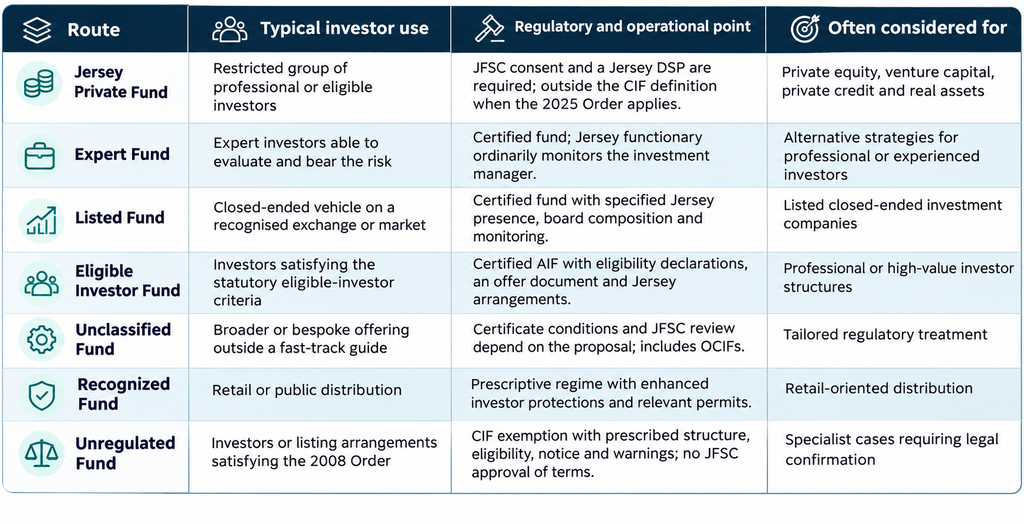
If you are planning a Jersey fund launch, We can help establish the accounting, administration and compliance processes needed for controlled delivery. The work is defined around operational outcomes and sits alongside, rather than replacing, your legal and regulatory advisers.
Jersey Private Fund requirements and operational implications
The JPF is a prominent private-capital route. Under the framework effective from 6 August 2025,the old 50-offer and 50-investor cap does not generally apply to a JPF with an appropriate new relevant consent. Consent conditions still matter: a very private JPF using a DSP without the specified fund services business registration classes is limited to 15 offers and 15 investors.Offers must instead be addressed exclusively to a restricted group: an identifiable category of people to whom the offer is directly communicated andonly members to whom the offer has been communicated may accept it. Existing JPFs authorised before that date retain their existing consent conditions unless and until a new relevant consent is issued. The JFSC’s JPF enhancement notice explains the transition.
Every investor must qualify as a professional investor or eligible investor under the current Jersey Private Fund Guide. One eligible-investor route is a minimum initial investment or commitment of GBP 250,000 or its currency equivalent, but the tests are alternatives rather than a universal threshold. Eligibility evidence, declarations and the required warning should be completed before admission.
A JPF must appoint a Jersey-based Designated Service Provider. The DSP makes the application, performs the responsibilities assigned by the Guide and submits the annual compliance return. It must undertake the required due diligence and notify material issues within the applicable timeframe. The governing body remains responsible for oversight.
The JFSC expects a JPF to be established in Jersey and/or to have its governing body and management and control in Jersey. The Guide expects one or more Jersey-resident directors on the JPF board or its governing body’s board, although it does not state an absolute rule for every case. The Guide does not require an auditor, but the structure, documents, investor terms or other laws may do so.
Removing the numeric cap does not remove investor-control work. The manager, governing body and DSP need an agreed process for approving the target category,checking eligibility on admission and applying the relevant transfer rules, obtaining declarations and warnings, and feeding restrictions into the register and reporting process.
Jersey Expert Fund
An Expert Fund is a Jersey collective investment fund available only to Expert Investors who acknowledge the prescribed warning. The definition includes investment professionals, qualifying institutions, connected participants and financial tests. One route is an individual net worth above USD 1 million excluding the principal residence; the complete definition must still be reviewed.
The Jersey Expert Fund Guide requires an administrator or manager, or in a specified closed-ended unit-trust case a trustee, with appropriate Jersey presence. That functionary ordinarily monitors the investment manager against documented investment and borrowing restrictions, keeps sufficient records in Jersey and escalates concerns. Reports should show how exceptions were detected and resolved.
For a private-equity sponsor raising from institutions and experienced principals, the operational test is whether providers and the board can produce the eligibility evidence, monitoring records, valuations and investor reporting promised in the fund documents.
Jersey Listed Fund
A Listed Fund is a Jersey-incorporated company that is closed ended and listed on a recognised stock exchange or market. Under the Listed Fund Guide revised on 1 June 2026, the fund company must have at least two appropriately experienced Jersey-resident directors, while a majority of the board, including the chair, must be independent. The board retains ultimate responsibility for management and control.
The fund must appoint an administrator and/or manager with the prescribed Jersey substance. Unless alternative arrangements are agreed with the JFSC, that provider monitors the investment manager. A single calendar should join valuation work, board approval, financial statements, exchange disclosures and investor communications.
Jersey Eligible Investor Fund
A Jersey Eligible Investor Fund is a certified AIF that may be open or closed ended.Acquisitions otherwise than by trade on a stock exchange or market are restricted to eligible investors under the statutory definition, subject to the required warning and declaration. Listed funds are also subject to the Guide’s specific conditions.It is built around controlled admission and transfer, not simply a high minimum subscription.
The Eligible Investor Fund Guideprovides for a Jersey company board with at least two appropriately experienced Jersey-resident directors, or equivalent Jersey arrangements for a limited partnership or unit trust.It also requires an offer document with material information on structure, providers, conflicts, strategy, dealing, valuation and other investor matters. The Guide requires an external auditor and sets custody requirements, including additional provisions for open-ended funds and specified exceptions.
The administrator and governing body need controls connecting subscription approval, declarations, transfer restrictions and register maintenance. Changes affecting the application or departing from the Guide must follow the applicable notification or consent process.
Unclassified and Recognized Funds
An Unclassified Fund is a CIF Law category rather than one standard product. Expert, Listed and Eligible Investor Funds are authorised forms of unclassified fund under their respective guides. Other proposals can be considered on a bespoke basis, with certificate conditions and scrutiny reflecting the structure, investor base and distribution plan. The JFSC’s open-ended unclassified collective investment fund guide, or OCIF Guide, applies to an OCIF offered to the general public.
Recognized Funds sit under a distinct, more prescriptive statutory regime for public or retail distribution. A manager should begin with the target market and distribution permissions, then test whether the legal, depositary, prospectus, dealing, valuation and reporting model can satisfy them.
What about Unregulated Funds?
The Collective Investment Funds Unregulated Funds Jersey Order 2008 creates two statutory categories: an unregulated eligible investor fund and an unregulated exchange-traded fund.The exchange-traded category requires a notice given before 1 April 2018, so that category is not available to a new launch under the current Order. The Registrar has accepted no new notifications since 1 April 2018. Funds notified before that date may continue until the end of their natural life.
For an unregulated eligible investor fund, the Order prescribes the Jersey structure, notice, investor tests, declarations and warnings. One investor route is an investment of at least USD 1 million, while other professional and wealth-based categories also apply. The fund is not approved or authorised by the JFSC, and the prescribed warning makes clear that the JFSC does not monitor its performance, supervise its management or protect investors. Procedures must keep the exemption conditions satisfied on an ongoing basis.
Unregulated does not mean operationally uncontrolled. Entity, financial-crime, service-provider, tax, marketing and contractual obligations can still apply. Legal advice is essential.
How AIFMD can affect Jersey funds marketed into the EU or EEA
Jersey is a third country for EU AIFMD purposes. Where a Jersey AIF or its manager markets into an EU or EEA state, the analysis commonly involves Jersey’s AIF Regulations and EU or EEA AIF Code, together with that state’s national private placement rules. A single approval does not create an automatic Union-wide marketing passport for a Jersey manager or fund.
From 16 April 2026, the JFSC’s EU or EEA AIF Code reflects AIFMD II.The JFSC says most changes apply to full-passport AIFs and managers and do not affect national private placement activity. The applicable rules still depend on the fund, manager, strategy and marketing jurisdiction; reporting and other obligations should be checked for the particular structure.A private-credit manager should ask advisers which loan-origination requirements, if any, apply in each relevant jurisdiction before settling product design, disclosures and reporting.
Marketing is assessed country by country and can turn on the communication, sender, investor and timing. Counsel should confirm the route before activity begins. Operations should maintain a jurisdiction register, approval gates, investor-location evidence and clear reporting ownership.
How fund regulation affects accounting administration and compliance
Legal classification becomes an operating model through assigned responsibilities and evidence.
Governance and provider oversight. The governing body should approve a responsibility map. Provider reports should show service levels, breaches, aged exceptions and remediation. Outsourcing does not remove oversight accountability.
Investor onboarding and ongoing eligibility.The onboarding team prepares due-diligence, eligibility, declaration, tax and side-letter records. A reviewer approves admission before units are issued.Transfers and ownership changes need controls appropriate to the applicable rules. For a JPF, eligibility assessed at admission may continue to be relied on after a change in investor status.
Accounting and NAV or valuation. Teams need controlled source data, reconciliations, valuation inputs, review thresholds and approval. Errors should enter an incident process covering impact, correction, communication and escalation. Project Accountants’ confirmed fund accounting services can help strengthen ledger control, resolve accounting backlogs and maintain accurate delivery through close, valuation and investor-reporting cycles.
Financial statements and audit. Confirm whether an audit is legally or contractually required and maintain an evidence timetable. Readiness includes reconciled ledgers, valuation support and disclosure ownership. Project Accountants can help organise the underlying accounting records and supporting evidence, but does not replace the fund’s auditor or assume the auditor’s responsibilities.
Compliance delivery. KYC reviews, screening, transaction-monitoring support, filings, breaches and remediation need review-ready records. Project Accountants’ compliance support can address defined onboarding, periodic-review or remediation workloads within the client’s control framework. Responsibility remains with the regulated entity and its appointed officers.
Investor and board reporting. Capital activity, statements, fees and performance data should reconcile to the accounting records. Board packs should identify unresolved differences, missed deadlines and provider failures.
What fund managers should prepare before launching a Jersey fund
- A current legal-entity and ownership chart showing the fund, manager, general partner, carry vehicles and service providers.
- A defined investor profile, including the eligibility route, evidence required and approval owner.
- A marketing-jurisdiction matrix covering proposed activity, legal advice, permissions and reporting.
- A service-provider model and responsibility matrix, including preparation, review, approval and escalation duties.
- The accounting basis, chart of accounts, opening-balance plan and data interfaces.
- An integrated reporting calendar for NAVs or valuations, investor reporting, board meetings, financial statements, audit and regulatory submissions.
- The onboarding and KYC workflow, including sanctions screening, declarations, transfer controls and periodic review.
- Banking and cash controls covering account opening, payment initiation, independent approval, fraud checks and reconciliations.
- A valuation or NAV policy with source data, committee or board approval, tolerance levels and error handling.
- An audit plan where relevant, including deliverables, evidence owners and issue clearance.
- A governance map showing reserved matters, delegated authorities, conflicts, breach escalation and provider oversight.
Where launch milestones, reporting cycles or operational backlogs put delivery at risk, our fund administration support can take on defined fund-setup and investor-operation activities. The support can be structured as outsourcing or specialist project support within the client’s systems, controls and governance framework.
How to choose the right Jersey fund route
Start with five linked decisions: who can invest; how investors will be approached; where marketing will occur; whether liquidity is open or closed ended; and what regulatory framework investors or counterparties expect. Legal form, listing plans, strategy and service-provider availability then narrow the routes.
For example, a sponsor raising a closed-ended real-assets fund from a small group of institutions may investigate a JPF because the offer is private and the investors can satisfy the relevant tests. A manager seeking a certified product for a broader expert-investor base may examine an Expert Fund. A sponsor planning exchange admission should assess the Listed Fund rules, board independence and exchange timetable. These are starting points for advice, not conclusions.
Before committing, run an operational feasibility review. Test whether the proposed providers can meet the eligibility, governance, monitoring, valuation, reporting and evidence requirements. The most suitable legal route can still underperform if data, ownership and deadlines are unresolved at launch.
Questions to ask advisers and service providers
- Which legal and regulatory route applies, and which alternatives were considered?
- Which investor test will be used for each investor category, and what evidence must be retained?
- What communications count as pre-marketing or marketing in each target jurisdiction?
- Which JFSC consents, certificates, registrations or notifications are needed, and who owns each filing?
- Which entity or provider performs the DSP, administrator, manager, monitoring or depositary role?
- What must the board approve, and what reporting will allow it to oversee delegated work?
- How will eligibility be checked on admission and the applicable transfer rules applied when ownership changes?
- What is the accounting and valuation basis, and who prepares, reviews and approves each NAV or valuation?
- Is an audit required by law, the fund documents, an investor agreement or another arrangement?
- How will breaches, valuation errors, late reports and provider failures be identified, escalated and remediated?
- Can each provider supply records promptly for board, auditor and regulatory review?
- How will EU or EEA marketing and AIFMD reporting be coordinated across jurisdictions?
Frequently asked questions
The Jersey Financial Services Commission regulates Jersey financial services and administers the relevant fund authorisation, certification and provider-regulation frameworks.
A JPF is authorised through the JPF Guide and COBO consent and, where the 2025 Order applies, is not a collective investment fund under the CIF Law. An Expert Fund is a certified collective investment fund for Expert Investors and is subject to the Certified Funds Code and Expert Fund Guide. Their service-provider, governance, disclosure and ongoing requirements differ.
Only investors satisfying a professional-investor or eligible-investor route in the current JPF Guide may invest. A GBP 250,000 minimum initial investment or commitment is one route, not the only test. The complete definition and any connected-person provisions should be checked for each admission.
Yes. A JPF must appoint a Jersey-based DSP that meets the Guide’s criteria and performs the specified application, due-diligence, compliance and reporting responsibilities.
Both are certified-fund routes, but they use different statutory investor definitions and guides. The Eligible Investor Fund is expressly an AIF and has its own eligibility declaration and structural requirements. Counsel should compare the intended investor base and operating model against both definitions.
It may be considered for a Jersey-incorporated, closed-ended fund intended for admission to a recognised exchange or market. Its board composition, Jersey administration or management presence and listing obligations must fit the proposal.
Potentially, subject to Jersey requirements and the national private placement or other rules of every target country. The route is jurisdiction-specific and should be confirmed before marketing begins.
The answer depends on the route and documents, but typically includes controlled onboarding data, ledgers and reconciliations, valuations or NAVs, capital activity, financial and investor reporting, board information, filing evidence and exception management.